The Electron and Electricity — From a Piece of Amber to a Particle That Is Also a Wave
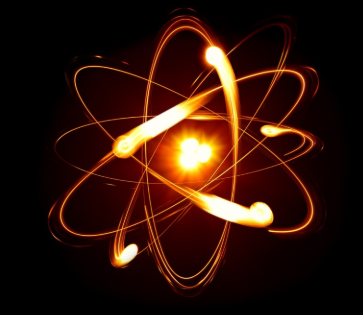
You press a switch and the lamp lights up in less than the blink of an eye. Behind that ordinary moment stands a long story that began more than two thousand six hundred years ago, with a golden-coloured stone that attracted feathers when rubbed with a piece of wool. That stone is amber, and from it — from nothing else — came the word "electron", and in Arabic the word for electricity itself.
Amber: the stone that named electricity
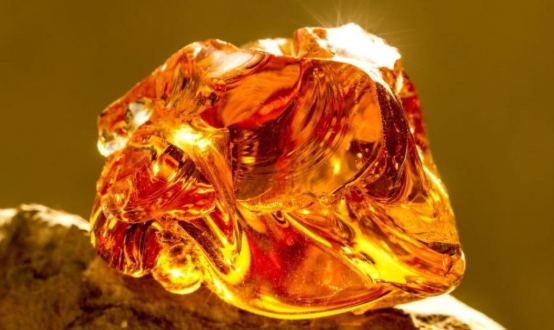
Amber is not really a mineral at all; it is fossilised tree resin. Sap flowed from the trunks of ancient conifers millions of years ago, then was buried, hardened, and was transformed by time and pressure into a solid, translucent, honey-coloured material.
And because the resin was sticky as it flowed, whatever passed by sometimes stuck to it: an insect, a leaf, a feather, or even a whole butterfly — preserved exactly as it was until today. Amber thus became a natural museum of creatures that went extinct in the remote past.

The journey of the name
The Greeks called amber ἤλεκτρον (elektron). The philosopher
Thales of Miletus (around 600 BCE) noticed that when this stone was rubbed with
wool or fur it attracted light objects such as straw and feathers. He did not know why, but he
recorded the observation — the first written observation of static electricity in history.
It remained a nameless curiosity until 1600 CE, when the Englishman
William Gilbert published his book De Magnete and derived from the Greek
word the term electricus to describe any material that behaves like amber when rubbed.
From that term came electricity.
Arabic followed exactly the same path: kahrabāʾ (electricity) comes from kahramān (amber), itself from the Persian kahrubā, "straw-attractor". So the name of the greatest force humanity uses today is taken literally from the name of a piece of fossilised resin.
Amber (fossilised resin) → elektron in Greek → electricus with Gilbert →
electricity and electron.
So "electron", at the root of the language, means: "the amber one".
A brief history: from spark to lightning bolt
For centuries people saw electric sparks without connecting them to anything. Thales was the first to notice and record the effect with amber. Then, in the seventeenth century, Otto von Guericke built the first machine for generating static electricity: a large sulphur globe that was spun and rubbed with the palm, producing visible sparks and audible crackles.
In 1745 the Leyden jar was invented — the first electrical capacitor in history — and it became possible to store charge and release it all at once. Spectacular demonstrations followed; the most famous involved shocking a line of hundreds of monks holding hands, who all jumped at the very same instant.
Franklin's kite experiment (1752)
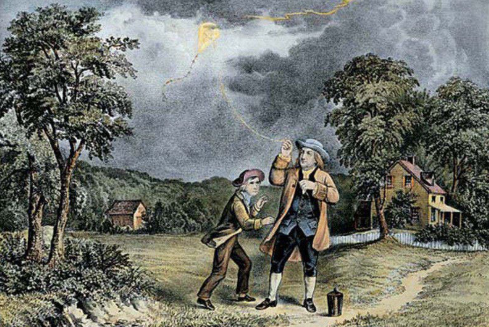
The great question of the time was: is the lightning in the sky the same spark we see in the laboratory, only on an enormous scale? Benjamin Franklin flew a kite on a stormy day with a metal key tied to the end of the string. As the string became soaked with moisture it turned conductive, charge travelled from the clouds down to the key, and a spark jumped from it when he brought his finger close — proving that lightning is an electrical phenomenon.
The practical fruit of that experiment was the lightning rod: a pointed metal rod fixed at the top of a building and connected to the ground, guiding the strike safely into the soil instead of letting it tear through the structure.
This experiment is extremely dangerous and can be fatal, and must never be repeated in any form. The Russian scientist Georg Richmann attempted it again in 1753, was struck by lightning and killed instantly.
Types of charge: why negative and positive?
Repeated experiments showed that there are two kinds of charge, and that like charges repel while unlike charges attract. It was Franklin himself who proposed calling them positive and negative, based on his picture of electricity as a "fluid" that becomes excessive in one body, making it positive, and deficient in another, making it negative.
And here is the point that must be perfectly clear: this naming is purely a convention. There is nothing in nature that makes the electron's charge "negative" in itself; had Franklin chosen the opposite, every sign in all our textbooks would flip and not one atom of the physics would change. But that choice left us with an amusing quirk we still live with: conventional current is drawn from positive to negative, while electrons actually flow in the opposite direction.
| Particle | Charge | Approximate mass | Location |
|---|---|---|---|
| Electron | Negative (−1) | 9.11 × 10⁻³¹ kg | Around the nucleus |
| Proton | Positive (+1) | 1.673 × 10⁻²⁷ kg | In the nucleus |
| Neutron | Neutral (0) | 1.675 × 10⁻²⁷ kg | In the nucleus |
Notice the astonishing difference: the proton is about 1836 times heavier than the electron. The electron is an extremely light particle, which is why it is so easily stripped away or transferred between objects — and that is exactly what happens when amber is rubbed with wool: electrons move from one to the other, the balance of charge is upset, and attraction appears.
The discovery of the electron (1897)
The "electron" remained a theoretical idea until the Englishman Joseph John Thomson came along. He was studying cathode rays: an evacuated glass tube with a high voltage applied across its ends, producing a beam that travels from the negative electrode to the positive one.
Thomson exposed this beam to electric and magnetic fields and it deflected, and the direction of the
deflection showed that it was negatively charged. He then measured the
charge-to-mass ratio e/m and was surprised to find it about a thousand times larger
than expected for any known ion — meaning these particles were far lighter than the
smallest atom.
More importantly, he repeated the experiment with different metals and gases and always obtained the same result, concluding that these particles are a common constituent of all matter. With that, the old belief that the atom was the smallest, indivisible thing in existence collapsed, and it was established that the atom has an internal structure. Thomson received the Nobel Prize in 1906.
In 1909 Robert Millikan completed the picture with his famous oil-drop
experiment, measuring the electron's charge precisely: e = 1.602 × 10⁻¹⁹ C, and proving
that electric charge is quantised — it always comes in whole multiples of this
fundamental unit and never in smaller pieces.
The dual nature: particle and wave together
Here begins the strangest chapter of the story. We knew the electron as a particle with mass and charge, until the Frenchman Louis de Broglie proposed a bold idea in 1924: if light — a wave — sometimes behaves like particles (as Einstein showed with the photoelectric effect), why should a particle not sometimes behave like a wave? He put it in a simple relation:
λ = h / p
where λ is the wavelength, h is Planck's constant, and p is the particle's momentum
Experimental confirmation came in 1927 from Davisson and Germer: they directed a beam of electrons at a nickel crystal and obtained a diffraction pattern — behaviour that only waves produce. The electron is therefore a wave and a particle at once, neither one alone; and what decides which face appears is the kind of experiment we perform.
From this followed Heisenberg's uncertainty principle: it is impossible to know an electron's position and its velocity together with perfect precision at the same instant. And so Bohr's orbit, drawn as a neat circular line, was replaced by the concept of the electron cloud — a region where the electron is likely to be found, not a definite track it follows.
The wave nature of the electron is no theoretical luxury: the electron microscope depends on it directly. Because the electron's wavelength is thousands of times shorter than that of visible light, we can see viruses and cellular details that an optical microscope can never reveal.
Conclusion
From a feather clinging to a piece of amber in a Greek philosopher's hand, to a key hanging from a kite string in a thunderstorm, to an evacuated glass tube that revealed a particle lighter than the atom, to a probability wave with no definite position — this is the journey of the electron. And today it underlies almost everything: the current in the wires, the image on the screen, the computation inside the processor, and the chemical bonds that build every substance in your body.