The Quantum Jump — When an Electron Travels Without a Path
Imagine you are on the first floor of a building, and then you are on the third — not by the stairs, not by the lift, and not by leaping from a window. You were never on the second floor, and never in the air between them for a single instant. You were here, then you were there, and you never existed anywhere in between.
This is precisely what an electron does inside an atom, millions of times every second. It is not science fiction; it is one of the best-established facts in modern physics, and its evidence is visible to your own eyes in every neon lamp and every star's light. It is called the quantum jump.
What is a quantum jump?
An electron in an atom is not free to take any amount of energy it likes. Only specific, countable energy levels are permitted to it — like the steps of a staircase, not a smooth ramp. And between one step and the next there is nowhere for it to stand.
When an electron absorbs enough energy, it moves from a lower level to a higher one (the atom is then said to be excited). When it falls back, it releases the energy difference as a photon — a single particle of light. In both directions the transition is not a journey: the electron does not traverse the distance between the two levels and is never seen halfway along. It disappears from here and appears there. That is the jump.
The energy of the emitted photon is exactly equal to the difference between
the two energy levels:
ΔE = E₂ − E₁ = h·f
where h is Planck's constant and f is the frequency of the light.
Because the energy levels are discrete, the emitted frequencies are
discrete too — and this is the idea on which everything that follows is built.
Who proposed it first?
The groundwork: Planck and Einstein
The idea was not born all at once. In 1900, the German Max Planck — struggling to explain black-body radiation — was forced to assume that energy is emitted and absorbed only in small, separate packets he called quanta. At the time he regarded it as a temporary mathematical trick rather than a physical truth.
Then in 1905 came Einstein, who explained the photoelectric effect by proposing that light itself consists of real energy packets (photons), not merely continuous waves — work for which he received the Nobel Prize in 1921. Quantisation had become a serious idea, but no one had yet carried it inside the atom.
Bohr, 1913 — the bold assumption
The problem was that Rutherford's model of the atom — electrons orbiting a nucleus — was impossible by the standards of classical physics. An accelerating charge radiates energy continuously, so the electron should have lost its energy and spiralled into the nucleus within a fraction of a billionth of a second. Yet atoms have been stable for billions of years. So why does matter not collapse?
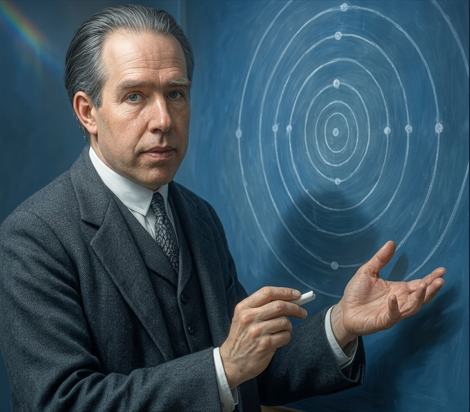
In 1913, the Dane Niels Bohr — then twenty-eight years old — offered a solution he could not justify but knew to work. He laid down two explicit postulates:
1) Stable orbits
The electron has only certain permitted orbits, and while in them it radiates no energy at all, however long it orbits. He called them "stationary states".
2) The jump
Radiation occurs only at the moment of transition between two orbits, as a photon whose energy exactly equals the difference between them.
To calculate the energy levels of the hydrogen atom, Bohr derived a strikingly simple formula:
Eₙ = −13.6 / n² eV where n = 1, 2, 3, …
So the first level is −13.6 eV, the second −3.4 eV, the third
−1.51 eV… and the higher the level, the closer the levels crowd together until
they converge at the ionisation energy of 13.6 electron volts — the energy
needed to tear the electron away from the atom altogether.
The postulate was undeniably "arbitrary" — imposed rather than derived from any deeper principle. That troubled a great many physicists. But in physics the verdict belongs not to elegance but to experiment. And this is where line spectra enter the story.
"Anyone who is not shocked by quantum theory has not understood it."
— Niels Bohr
The evidence: line spectra
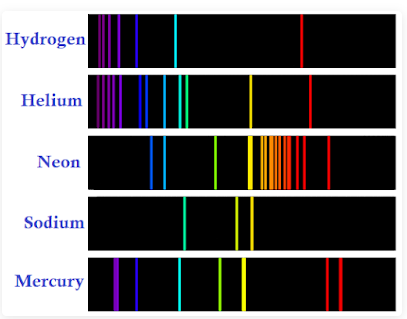
Pass sunlight through a prism and you get a continuous spectrum: every colour blending into the next without a break, like a rainbow. But take a tube of hydrogen gas, excite it electrically and pass its light through a prism, and you get no rainbow at all — only a few thin coloured lines separated by complete darkness.
Look closely at the image above: each element has a completely different pattern of lines. Hydrogen has its lines, helium has its own, and neon has that crowded red-orange thicket. The pattern is fixed, never changing, and never repeated in two elements — it is a fingerprint in the fullest sense of the word.
Why was this a mystery?
Classical physics had no explanation whatsoever. If an electron could lose any amount of energy, it should emit every frequency — that is, a continuous spectrum. So why these particular frequencies and no others? And why are they always the same?
A Swiss mathematics teacher named Johann Balmer had discovered in 1885 — by pure numerical trial and error, with no physical understanding at all — a simple formula giving the wavelengths of hydrogen's visible lines with astonishing accuracy. A formula that worked, and nobody knew why.
How Bohr settled the mystery
Bohr's explanation is direct and beautiful: every line in the spectrum is one specific quantum jump. Because the energy levels are discrete, the energy differences are discrete, so the emitted photons have discrete energies, so their colours are discrete. The lines are separate because the levels are separate. And the darkness between the lines is the visible proof that everything between the levels is forbidden.
More importantly still: when Bohr calculated the wavelengths from his theoretical formula, they came out identical to Balmer's experimental numbers. The theory did not merely describe the phenomenon — it derived an empirical law that had been a puzzle for twenty-eight years. That was the decisive evidence, and it earned Bohr the Nobel Prize in 1922.
| Line | Transition | Wavelength | Colour |
|---|---|---|---|
| Hα | n=3 → n=2 | 656.3 nm | Red |
| Hβ | n=4 → n=2 | 486.1 nm | Blue-green |
| Hγ | n=5 → n=2 | 434.0 nm | Blue-violet |
| Hδ | n=6 → n=2 | 410.2 nm | Violet |
This is the Balmer series — the jumps that end at the second level, and the only ones falling in the visible range. Jumps ending at the first level (the Lyman series) lie in the ultraviolet, and those ending at the third (the Paschen series) lie in the infrared — so the eye never sees them.
Helium was discovered in the Sun before it was found on Earth. In 1868 a yellow line was observed in the Sun's spectrum belonging to no known element, so the element was named helium after Helios, the Greek god of the Sun — and it was not found terrestrially for another twenty-seven years. In this way quantum jumps became a language in which we read the composition of the stars while sitting on our own planet.
An important correction: what did we learn after Bohr?
Bohr's model was a tremendous leap, but it was not the last word. It succeeds for hydrogen (one electron) and fails for more complex atoms; it explains neither the intensities of the lines nor their splitting in a magnetic field.
With quantum mechanics, developed by Schrödinger and Heisenberg (1925–1926), the picture changed: the electron is not a ball travelling in a definite orbit but a probability cloud (an orbital). What we call a "jump" is a transition between two quantum states — the probability of finding it in the first state fades while the probability of the second grows.
And here is the point most often misunderstood: a quantum jump is not a movement through space at all; it is a change of energy state. The electron does not "travel" from one point to another — the whole distribution of the probability of finding it around the nucleus changes at once. The name suggests travel; the reality is deeper than that, and stranger.
Experiments that support the idea — and revise it
Watching the jump on a single atom (1986)
For many years the jump remained an inference from spectra rather than a direct observation, until several research groups succeeded in 1986 in trapping a single ion in an electromagnetic trap and watching its light. The result was remarkable: the ion glows steadily, then abruptly goes completely dark for a while, then just as abruptly starts glowing again. This intermittent blinking (quantum jumps, or "shelving") is the quantum jump observed on a single atom, not inferred from millions of them.
The jump caught mid-flight (2019)
Then in 2019, Michel Devoret's group at Yale University published a paper in Nature that changed the picture. Using a superconducting qubit and extremely fast monitoring, they showed that a quantum jump — despite beginning at a random, unpredictable moment — is not instantaneous at all. It is a continuous process that takes a measurable amount of time.
More striking still: they were able to detect an early warning signal preceding the jump, then reverse it midway and return the system to its original state before the jump completed. The paper's own title was: "To catch and reverse a quantum jump mid-flight".
The quantum jump is real and observed, but it is not an instantaneous transition at infinite speed. It is a transition that is abrupt in its timing, random in its occurrence, and continuous in its course. This distinction is the key to everything in the next section — anyone who builds on "instantaneity" is building on an understanding that experiment has already moved past.
So what does it mean? Can matter be transported with no travel time?
This is the question that leaps to mind immediately: if an electron moves without crossing the distance, why should a human being not do the same? The answer needs unpacking, because science here says both "yes" and "no" — each about a different thing.
First: the quantum jump itself is not transport through space
As we saw, the electron does not move from place to place in a jump; its energy level changes. So invoking the quantum jump alone to justify transporting objects through space is a misplaced analogy. Fortunately, there is another phenomenon far closer to what we want.
Second: entanglement and quantum teleportation — the transport that really happens
Quantum entanglement is a phenomenon confirmed by experiment again and again: two particles become linked such that measuring the state of one immediately determines the state of the other, however far apart they are. This is what Einstein rejected, mocking it as "spooky action at a distance" — and then experiment settled the matter against him, with entanglement research receiving the 2022 Nobel Prize in Physics.
On this foundation rests quantum teleportation, proposed theoretically in 1993 and first realised experimentally in 1997. By 2017 it had reached a range of over 1,400 kilometres, from the ground to the Chinese satellite Micius. Yes — this actually happened, and it is not fiction.
1) What is transported is information, not matter. Not a single atom travels from one place to another. What is transferred is the quantum state, which is then imprinted on a particle already present at the other end. It is more like transferring the "file" than the hard drive itself.
2) A classical channel is indispensable. To complete the process, a measurement result must be sent by ordinary means (radio, optical fibre). Without that message the other end remains meaningless random noise. And because ordinary messages are limited by the speed of light, quantum teleportation neither exceeds nor breaks the light-speed limit — relativity is entirely intact, and there is no transport "without time".
3) The original is necessarily destroyed. The no-cloning theorem (1982) states that an unknown quantum state cannot be copied. A copy can only be made at the cost of the original's destruction. So "transport" here is in reality destruction here and reconstruction there — a philosophical problem before it is a physical one, if a human being is involved.
What are the challenges in transporting large objects?
1) Decoherence — the primary enemy
Quantum behaviour is fragile beyond belief. The moment a quantum system "interacts" with its surroundings — an air molecule strikes it, a thermal photon passes, the slightest vibration — it collapses into ordinary classical behaviour. This is why quantum experiments are conducted in near-perfect vacuum at temperatures close to absolute zero. And the larger the object, the more it interacts with its surroundings, so its entanglement collapses incomparably faster. This is the root reason we never see quantum phenomena in everyday life.
2) The volume of information — a number beyond imagining
A human body contains roughly 1028 atoms. Teleporting it quantum mechanically would require not merely the positions of those atoms but the complete quantum state of every particle in it — a quantity of data vastly exceeding all the information humanity has ever produced. Physics students at the University of Leicester estimated in 2012, in an entertaining back-of-the-envelope paper, that transferring one human being at the best available data rates would take some 4.85 × 10¹⁵ years — roughly 350,000 times the age of the universe.
3) Where have we actually got to?
The progress is real but on very small scales. Molecular interference experiments have demonstrated quantum wave behaviour for enormous molecules exceeding 2,000 atoms as of 2019 — an astonishing achievement, yet still smaller than a single virus. The distance from there to a living body is not a large step but a different kind of problem altogether.
What has actually worked
Transferring the states of photons, atoms and qubits over distances up to 1,400 km — the basis of future quantum encryption networks.
What has not
Transporting any material mass. Even a single bacterium is far beyond us today, let alone a complex living creature.
What is theoretically impossible
Sending information faster than light, and copying a quantum state without destroying the original. Both are constraints built into physics itself.
Are scientists still working on this?
Yes, intensively — but for a purpose other than transporting objects. Entanglement and quantum teleportation are today the backbone of three fields on which nations are spending billions:
- Quantum computing: machines that solve in minutes problems our computers could not finish in millions of years.
- Quantum cryptography: communications that are in principle impossible to eavesdrop on, because the very act of observing corrupts the state and exposes the listener.
- The quantum internet: a network linking quantum computers through "quantum repeaters" that rely on teleportation between nodes.
As for transporting people, it is not an active research programme in any serious laboratory in the world today. Not because it is forbidden to think about, but because the road to it has not yet been opened.
The quantum jump in science fiction
Perhaps no idea in physics has been seized upon by science fiction as thoroughly as this one. Its most famous incarnation is the Star Trek transporter and its immortal line "Beam me up" — which was in fact invented for an amusingly practical reason: filming a spacecraft landing on a planet every episode was ruinously expensive, so instant transport was a solution to the budget before it was ever a scientific idea.
The Fly presented the idea's horrifying face: an error in transport merges the scientist's DNA with that of a fly that entered the chamber with him. Terrifying as it is, it touches a genuine problem: the accuracy of reconstruction.
And there remains the philosophical question no one has yet answered: if you are destroyed here and an exactly identical copy of you is rebuilt there — with all your memories and thoughts — is the one who arrived you, or a copy of you while you yourself died?
A personal view — the throne of Bilqīs
Everything above is science as experiment establishes it. What follows is a personal view of the author, offered as a reflection and a personal reading rather than an established scientific fact, for the reader to consider and judge.
In Sūrat al-Naml there is an account of the throne of Bilqīs being brought from Yemen to the Levant in less than the blink of an eye:
﴿قَالَ يَا أَيُّهَا الْمَلَأُ أَيُّكُمْ يَأْتِينِي بِعَرْشِهَا قَبْلَ أَن يَأْتُونِي مُسْلِمِينَ﴾
﴿قَالَ عِفْرِيتٌ مِّنَ الْجِنِّ أَنَا آتِيكَ بِهِ قَبْلَ أَن تَقُومَ مِن مَّقَامِكَ ۖ وَإِنِّي عَلَيْهِ لَقَوِيٌّ أَمِينٌ﴾
﴿قَالَ الَّذِي عِندَهُ عِلْمٌ مِّنَ الْكِتَابِ أَنَا آتِيكَ بِهِ قَبْلَ أَن يَرْتَدَّ إِلَيْكَ طَرْفُكَ ۚ فَلَمَّا رَآهُ مُسْتَقِرًّا عِندَهُ قَالَ هَٰذَا مِن فَضْلِ رَبِّي لِيَبْلُوَنِي أَأَشْكُرُ أَمْ أَكْفُرُ ۖ وَمَن شَكَرَ فَإِنَّمَا يَشْكُرُ لِنَفْسِهِ ۖ وَمَن كَفَرَ فَإِنَّ رَبِّي غَنِيٌّ كَرِيمٌ﴾
"He said: O chiefs, which of you will bring me her throne before they come to me in submission?"
"A powerful one from among the jinn said: I will bring it to you before you rise from your place, and indeed I am strong and trustworthy for this task."
"Said the one who had knowledge of the Scripture: I will bring it to you before your glance returns to you. And when he saw it settled before him, he said: This is from the favour of my Lord, to test me whether I am grateful or ungrateful. And whoever is grateful, his gratitude is only for his own benefit; and whoever is ungrateful — then indeed, my Lord is Free of need and Generous."
— Sūrat al-Naml: 38–40 (interpretation of the meaning)
I personally believe that the throne of Bilqīs was moved by means of a science we have not yet reached, rather than as a miracle breaking the laws of nature. What draws me to this reading is that the text itself describes the agent as "the one who had knowledge of the Scripture" — the description is knowledge, and the agent was neither a prophet nor a messenger. A miracle, in the technical religious sense, occurs at the hands of a prophet in support of his prophethood, and this is not one of those.
I would also draw attention to the comparison the text itself makes between two capabilities: the jinn promises to bring it "before you rise from your place", while the one with knowledge of the Scripture promises it "before your glance returns to you" — that is, knowledge was faster than power. To my mind that is a striking detail.
And the interpretations religious scholars have offered for these verses — with all due respect to their standing — are human reasoning, not revelation, and so are not binding upon me or upon anyone else. So is the transport of large objects merely a matter of time, until humanity's knowledge reaches far enough to open this door?
The above is a personal reflection from which no scientific or religious ruling follows. Physics today says plainly that the quantum teleportation we possess transfers state, not matter, and that it does not exceed the speed of light. Intellectual honesty requires us to distinguish between what we know, what we hope and what we interpret — burdening neither the text with what it cannot bear, nor science with what it has not said.
Conclusion
The story began with a puzzle in a glass tube: why does hydrogen give four coloured lines rather than a rainbow? It ended by reshaping our understanding of reality itself. The quantum jump taught us that nature, at its depths, is discrete rather than continuous, and that the question "where was the electron along the way?" may have no answer because it is a meaningless question to begin with.
As for transporting objects with no travel time, what we possess today is the transfer of information, not matter, and it is bound by the speed of light rather than freed from it. But the history of science reminds us of something: who could have told Balmer in 1885, as he played with numbers, that his formula would be a key to the structure of the atom? And who would have guessed that a "mathematical trick" Planck resorted to reluctantly would bring down the whole of classical physics?
The difference between "impossible" and "we do not yet know how" is the difference that has produced every scientific revolution in history. And the quantum jump — of everything in physics — is the sharpest reminder that the universe is under no obligation to respect our intuitions about what is possible.