Time and Gravity — Why a Second Is Not the Same for Everyone
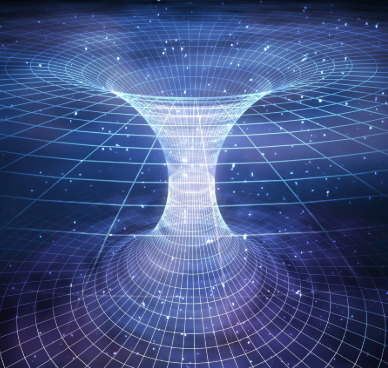
Look at your watch. Its hand moves with unfailing regularity, and it feels obvious that the second which just passed for you passed at the very same instant for every human on Earth and every star in the sky. That simple, obvious feeling is completely wrong.
At this very moment, the clock at your feet runs slower than the clock at your head. The astronaut orbiting above you is ageing slightly more slowly than you are. And the atomic clock aboard a GPS satellite runs ahead of yours by 38 microseconds every day — if engineers did not correct for that, your phone's map would drift off by ten kilometres a day.
Time is not one cosmic clock hanging above existence. It is local: everyone has their own, set by where they are and how fast they move. This article tells how we found that out, how it became measurable with the finest instruments we have, and where it leads when pushed to the limit at the edge of a black hole.
1. What is time? — a question that runs away as you approach it
The most famous answer was given by Augustine sixteen centuries ago. Asked what time is, he replied — in essence — that if nobody asks him, he knows; but if he is asked and has to explain it, he no longer knows. That answer still holds today.
The trouble is that every definition we attempt closes into a circle: we say time is what separates two events, then notice that "separates" already presupposes time. So physicists escaped the philosophical question into an operational one that needs no philosophy at all:
Time is what a clock measures.
— an answer attributed to Einstein, and the sharpest one we have
That may look like an evasion, but it is in fact the deepest point of the whole subject. It turns time from an abstract idea into a physical quantity measured by a device — and once a device measures it, the reading may differ from device to device depending on its circumstances. That is exactly the door Einstein opened.
Since 1967 the second has no longer been a fraction of Earth's rotation —
because that rotation is itself irregular and slowing. The second is now defined as the
time it takes a caesium-133 atom to complete
9,192,631,770 oscillations of its characteristic radiation. Today
optical atomic clocks have gone far beyond that precision; some would not
lose a single second over the entire age of the universe — and work is
under way to redefine the second in terms of them.
So why does time still puzzle scientists?
For all our precision in measuring time, we still do not know what it is. Three great puzzles remain open:
The arrow of time
The fundamental laws of physics work equally well in both directions, so why does time run only forward? Our best answer is entropy: the universe began in an extremely ordered state and is heading toward disorder, and that direction is what we feel as "passing".
Is "now" real?
Relativity has no universal shared "now"; what is present for you may be past for someone else. This leads to the block universe idea: past, present and future all exist, and we move through them.
Time disappears!
When we try to merge general relativity with quantum mechanics, the Wheeler–DeWitt equation for the whole universe appears — and it contains no time variable at all. Physicists call this "the problem of time".
2. Newton's time — the absolute river
In his Principia of 1687, Isaac Newton wrote a line that governed physics for two centuries: absolute, true time flows of itself, equably, without relation to anything external.
Picture a giant cosmic clock hanging outside the universe: it ticks once, and the same second passes at the same instant on Earth, on Jupiter and in the most distant galaxy. For Newton space was a fixed stage, time a single unchanging ruler, and gravity a force pulling bodies toward one another across empty space.
It was an intuitive, comfortable picture, and it succeeded brilliantly at computing planetary orbits. But it had a gap that troubled Newton himself: how does gravity travel? How does the Earth "know" the Sun is there, with nothing in between, and instantly? If the Sun vanished, would Earth swerve at once? Newton admitted he had no answer, and left the question hanging for two hundred years.
3. Einstein's time — a fourth dimension that bends
1905 — special relativity: motion slows time
Einstein started from one strange principle that experiment had confirmed:
the speed of light is the same for every observer, whatever their own speed.
Fire a beam while standing still, and let a rocket chasing you at half the speed of light
measure it: it gets exactly the same number, about 300,000 km/s.
That is not a small detail — it is a bombshell. Speed = distance ÷ time. If speed is the same for everyone despite their different motion, only one conclusion is left: distance and time are what change.
Δt' = Δt / √(1 − v²/c²)
As v approaches the speed of light the denominator approaches zero and time
stretches without limit. At everyday speeds v²/c² is so tiny that we feel
nothing — which is exactly why our senses misled us for our whole history.
1915 — general relativity: gravity is not a force at all
Then came the idea Einstein called "the happiest thought of my life": a man in free fall does not feel his own weight. Which means gravity and acceleration are one and the same, indistinguishable inside a closed room — the equivalence principle.
From it Einstein built a new picture of the whole universe: space and time are not two separate things but one four-dimensional fabric called spacetime. Every mass produces a curvature in that fabric. The Earth does not orbit the Sun because the Sun pulls it with an invisible rope, but because it follows the straightest possible path through curved spacetime.
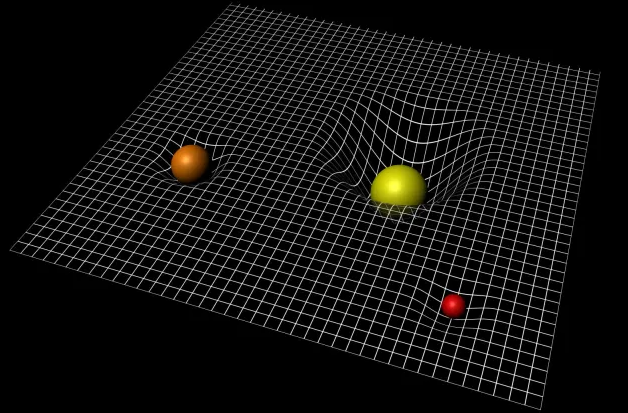
Spacetime tells matter how to move; matter tells spacetime how to curve.
— John Wheeler, summarising general relativity in a single line
And here is the crux of this article: the curved fabric is not the fabric of space alone — it is space and time together. When the region near a large mass bends, the time axis itself bends with it, so time there runs slower. This is gravitational time dilation:
Δt' = Δt × √(1 − 2GM/rc²)
where M is the mass and r your distance from its centre. The more
mass or the smaller the distance, the smaller the square root and the slower time runs.
Time runs more slowly down below, where gravity is stronger.
The stretched rubber sheet you see in every illustration — including the images in this article — is only an analogy: it draws just two of the four dimensions, and it uses gravity itself to explain gravity! Treat it as visual sign language, and remember that the mathematical truth is deeper: a curvature in four dimensions, of which the time direction takes the largest share.
4. The smallest possible time — the Planck time
If time stretches and shrinks, can it be cut up without limit? Here a strange threshold
appears, found by Max Planck in 1899 when he tried to build "natural" units
that owe nothing to humans, combining just three cosmic constants: the gravitational constant
G, Planck's constant ħ, and the speed of light c.
t_P = √(ħG/c⁵) ≈ 5.39 × 10⁻⁴⁴ seconds
A number impossible to picture: the ratio of the Planck time to one second is far smaller
than the ratio of one second to the age of the universe multiplied millions of
times over.
What does it mean? It is often called "the smallest possible unit of time" or "the pixel of time", but the truth is sharper and more modest: the Planck time is the limit at which our present physics breaks down. Below that scale, quantum effects on spacetime itself become enormous, and we have no theory of quantum gravity to describe what happens. Saying "time is chopped into Planck units" is a hypothesis in some theories (such as loop quantum gravity), not an established fact.
It has another cosmological meaning. Tracing the Big Bang backwards, we can describe the universe only down to an age of about 10⁻⁴³ seconds. Before that — the "Planck epoch" — there is total silence. Not because nothing happened, but because our physical language ends there.
5. Does time differ from person to person and place to place?
Yes — and this is now among the most thoroughly confirmed facts in all of physics. The difference comes from exactly two causes, which may add up or work against each other:
| Cause | Rule | Whose time slows | Example |
|---|---|---|---|
| Speed special relativity |
The faster you move, the slower your time relative to someone at rest | The fast mover | Astronauts, muons, accelerator particles |
| Gravity general relativity |
The stronger the gravity where you are, the slower your time relative to someone higher up | The one closer to the mass | A ground-floor resident, a diver, the surface of a neutron star |
The effect is real even inside your own body: your feet are closer to Earth's centre than your head, live in slightly stronger gravity, and run slightly slower. The gap amounts to something like a hundredth of a nanosecond over a whole lifetime — imperceptible, yet genuinely measurable in the laboratory, as we shall see.
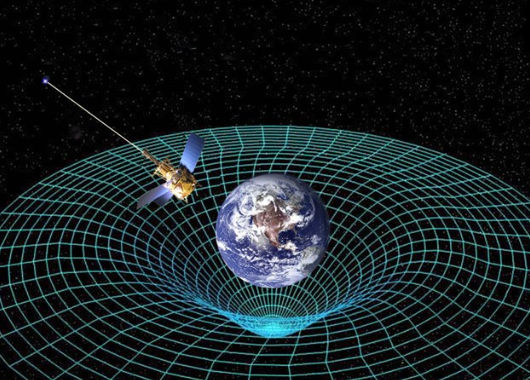
6. See the curvature for yourself — an interactive simulation
Static pictures show the result but not the act. In the simulation below we placed a cube of spacetime and set a very massive body moving inside it. Watch how the grid lines are drawn toward it wherever it goes, and how they straighten again once it moves away. At the same time, watch the two clocks: one far away in deep space, and one fixed at a point the body sweeps past — and see the gap between them build up in front of you.
A cube of spacetime — a body moves, the fabric bends, and time falls behind
Note: the numbers here are hugely exaggerated so the effect is visible within seconds — around ordinary planets it is far too small to see without an atomic clock. The cube represents a volume of spacetime, and its lines are not physical wires but a geometric guide showing how measurement itself is distorted near a mass.
7. The evidence — time really does slow, and experiments measure it
This is neither philosophy nor speculation. Time dilation is now measured routinely in the laboratory, and these are the classic experiments that established it:
| Experiment | Year | What it did | Result |
|---|---|---|---|
| Cosmic-ray muons | 1941 onwards | Particles created high in the atmosphere with a lifetime of only 2.2 microseconds — not enough to reach the ground | They arrive in large numbers! Their high speed stretched their time dozens of times over |
| Pound and Rebka | 1959 | Measured the frequency shift of gamma rays between the top and bottom of a 22.5 m Harvard tower | The observed shift matched Einstein's prediction — height alone changes the pace of time |
| Hafele and Keating | 1971 | Four atomic clocks flown around the world on airliners, eastward then westward | They returned differing from ground clocks by hundreds of nanoseconds — exactly as predicted |
| Gravity Probe A | 1976 | A hydrogen maser clock launched to 10,000 km and compared with its twin on the ground | The higher clock ran faster — agreeing to about one part in 10,000 |
| NIST optical clocks | 2010 | Raised one of two identical atomic clocks by just 33 centimetres | The difference showed up! A third of a metre of height is enough to change time measurably |
| JILA clocks | 2022 | Measured the time difference across an atomic sample one millimetre tall | It worked — time dilation is now visible on the scale of a hair |
| The star S2 around Sgr A* | 2018 | Tracked starlight passing close to the supermassive black hole at our galaxy's centre at 2.5% of light speed | Its light reddened by exactly the predicted amount — time dilation observed 26,000 light-years away |
Because light is a wave, and a wave is a clock: its frequency counts oscillations per second. If the second down there is "longer" than ours, the light reaches us with fewer oscillations — a lower frequency and a longer wavelength. That is the gravitational redshift. Light does not lose speed; it carries with it a certificate of how slowly time ran where it came from.
8. Practical applications — where do we use this every day?
1) GPS — the most famous application of all
GPS satellites orbit at about 20,200 km at roughly 14,000 km/h. Their clocks feel two opposing effects:
- Gravity is weaker up there, so their clocks gain
+45microseconds per day. - Their speed is high, so their clocks lose
−7microseconds per day. - Net result:
+38microseconds a day ahead of ground clocks.
Since the receiver locates you from the travel time of the signal, an error of
38 microseconds means a distance error of
38×10⁻⁶ × 300,000 km/s ≈ 11.4 km — per day, and it accumulates.
That is why satellite clocks are deliberately set to a slightly slower rate before launch, so
that relativity brings them right once they are in orbit.
Every time your phone guides you to a destination within a few metres, you are using — without knowing it — both theories of relativity. Einstein's abstract ideas about curved time have become an engineering requirement in a device in your pocket.
2) Chronometric levelling — measuring the land with clocks
Since the pace of time changes with height by a precisely known amount, the equation can be inverted: compare two atomic clocks and deduce the height difference between them. This emerging field is called chronometric geodesy, and it promises to map terrain and sea-level change to centimetre accuracy — with a clock rather than a surveyor's level.
3) Particle accelerators
In the Large Hadron Collider, particles circulate at nearly the speed of light and their time stretches thousands of times over. Without accounting for that precisely, physicists could never study particles whose natural lifetimes are billionths of a billionth of a second.
4) Interplanetary navigation
Signals from space probes sometimes pass close to the Sun and are delayed by the curvature of spacetime — the Shapiro delay, measured to high precision. Correcting for it is essential for locating spacecraft and computing their trajectories.
9. Massive stars and black holes — where time stops
The more mass we squeeze into less space, the sharper the curvature and the slower time runs. This diagram compares three cases:
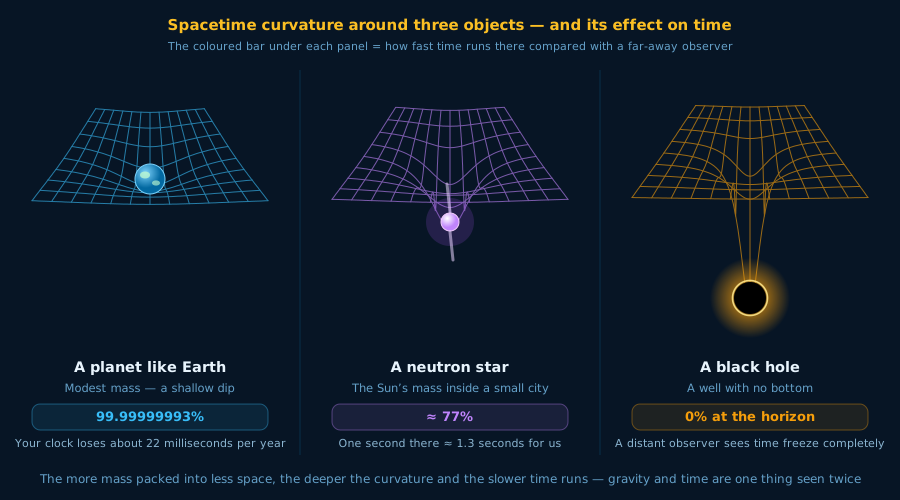
- A planet like Earth: time at its surface runs slower than in deep space by about seven parts in ten billion — your clock falls behind by roughly 22 milliseconds a year.
- A neutron star: more mass than the Sun packed into a ball 20 kilometres across. Time at its surface runs at about 77% of our pace — one second there corresponds to roughly 1.3 seconds here.
- A black hole: at the event horizon the square root reaches zero, and time stops completely as far as a distant observer is concerned.
You would see them slow down and slow down as they approached the horizon,
their light reddening and dimming, until they froze at the edge in your view and
never crossed it — fading away without ever going in.
They, meanwhile, would notice nothing odd about their own watch! They cross the horizon in a
finite proper time, with no bell to mark the fateful moment. Both descriptions are
correct — because the question "when did they cross?" has no single cosmic answer,
only one answer per observer. This is the relativity of time at its most extreme.
The centre of the Earth is younger than its crust! Gravity is stronger at the centre and time runs slower there; over the Earth's 4.5-billion-year life the accumulated difference comes to about two and a half years. As for the film Interstellar, its famous scene rests on the same physics: Miller's planet orbits close to a supermassive black hole, so every hour there equals seven years aboard the mother ship — and the arithmetic is physically sound, supervised by the Nobel-winning physicist Kip Thorne.
10. Does time in space run slower than on Earth?
This is a common question, and the answer depends on which "space" you mean — because the two effects compete: moving away from Earth speeds time up, while high speed slows it down. Whichever wins decides the outcome:
| Location | Gravitational effect | Speed effect | Net result vs Earth's surface |
|---|---|---|---|
| International Space Station 400 km, 7.7 km/s |
speeds up slightly | slows down a lot | Slower — the astronaut ages less |
| GPS satellites 20,200 km, 3.9 km/s |
speeds up a lot | slows down slightly | Faster by 38 microseconds a day |
| A mountain top | speeds up slightly | negligible | Faster by a minute amount |
| The ocean floor | slows down slightly | negligible | Slower by a minute amount |
| Intergalactic space | almost no gravity well | negligible | The fastest time possible — the universe's "reference time" |
Astronaut Scott Kelly, who spent 340 days aboard the ISS, came home having aged about 8.6 milliseconds less than his twin brother. A tiny number — but real twins, a real measurement, and the twin paradox lifted off the page and into orbit.
11. The twin paradox
Two twins: one stays on Earth, the other flies to a distant star at near light speed and returns. When they meet, the traveller really is younger. He may experience two years of travel while twenty years pass for his brother.
The "paradox" is that motion is relative: why not say Earth flew away and came back, making the stay-at-home the younger one?
The stay-at-home twin remained in a single inertial frame the whole time.
The traveller changed frames: he accelerated at launch,
reversed direction at the star, then decelerated on return. That turn-around
is what breaks the symmetry — and it is a physical event the traveller feels in his body
while his brother feels nothing.
The most elegant way to put it: the time each one lives is the length of his path
through spacetime, just like the length of a road between two cities. The straight
path is the longest in time; the bent path is shorter.
The traveller took a bent path, so he lived a shorter time. No paradox —
just geometry.
12. Does time pass for light?
This is the very question that started everything. At sixteen, Einstein asked himself: what would I see if I rode a light beam alongside it? The puzzle chased him for ten years, until special relativity was born.
Apply the equation: Δt' = Δt/√(1 − v²/c²). At exactly v = c the root
becomes zero. And in the language of the spacetime interval — the true
separation between two events in spacetime — the interval along a photon's path is
exactly zero.
People often say: "no time passes for a photon, so the moment it left a star a billion years
ago is the same moment it reaches your eye." That is a useful picture, but the accurate
statement is that a photon has no reference frame at all. Relativity builds
observer frames on massive objects moving slower than light; set v = c and the
equations collapse (division by zero) and the question loses physical meaning.
So if a human "rode" a light pulse, their time would not freeze — rather, the question
itself does not arise, because a human has mass, and bringing any mass to the speed of light
requires infinite energy. This is among the deepest lessons of relativity:
some questions are answered neither "yes" nor "no", but by noting that
the question lies outside what the theory describes.
13. A Qur'anic hint at the relativity of time's measure
It is striking that the Qur'an does not give time one absolute measure, but mentions it with different measures that vary with who is measuring. In Sūrat al-Ḥajj:
﴿وَيَسْتَعْجِلُونَكَ بِالْعَذَابِ وَلَن يُخْلِفَ اللَّهُ وَعْدَهُ ۚ وَإِنَّ يَوْمًا عِندَ رَبِّكَ كَأَلْفِ سَنَةٍ مِّمَّا تَعُدُّونَ﴾
— Sūrat al-Ḥajj, verse 47 — “…and indeed, a day with your Lord is like a thousand years of those which you count.” (translation of the meaning)
And in Sūrat al-Maʿārij:
﴿تَعْرُجُ الْمَلَائِكَةُ وَالرُّوحُ إِلَيْهِ فِي يَوْمٍ كَانَ مِقْدَارُهُ خَمْسِينَ أَلْفَ سَنَةٍ﴾
— Sūrat al-Maʿārij, verse 4 — “The angels and the Spirit ascend to Him in a Day the measure of which is fifty thousand years.” (translation of the meaning)
What stands out is that the measure of a day is not given as one fixed number: a day with your Lord is like a thousand years of those which you count, while another day measures fifty thousand years. The phrase "of those which you count" ties the counting to the counter — the measure is referred to whoever is measuring.
We are not claiming these verses are physics equations, nor making theories — which are always open to revision — a judge over scripture. Yet it remains striking that a text from fourteen centuries ago points to the measure of a day differing with the frame and the station, at a time when all humanity took time to be one absolute river, as Newton himself would take it centuries later. We offer it as an invitation to reflect, not as forced proof.
Conclusion
We began with a watch on your wrist that seemed a neutral judge over existence, and ended with the realisation that it is your watch and yours alone: it runs at a pace set by your position in the gravity well and your speed through space. There is no single cosmic clock, no "now" that spans the universe, no absolute arbiter.
And yet the universe is not chaos: every observer measures a different time, but all of them agree on the spacetime interval — the quantity that combines space and time and comes out the same for everyone. The appearances differ; the essence agrees.
Perhaps the greatest lesson of this story is that what seems most obvious deserves our doubt first. The second that passed while you read this line was nobody's second but yours — and it will not come back.