Chernobyl — The Night the Impossible Exploded
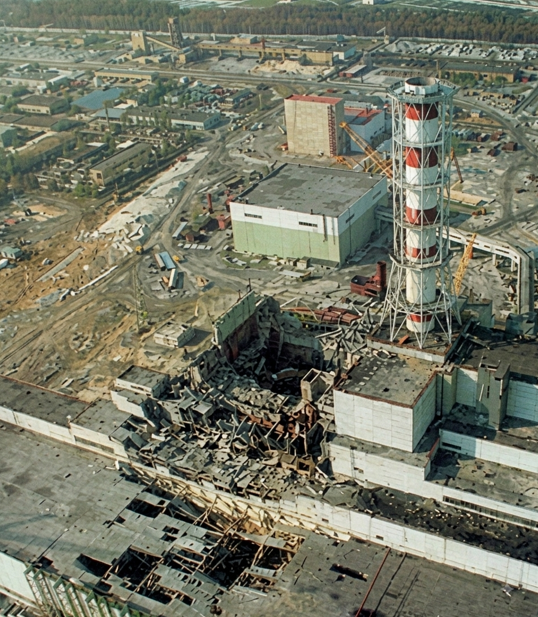
The night
01:23:40. Friday, 26 April 1986.
In Control Room No. 4, shift engineer Alexander Akimov had decided to bring this long night to an end. The test they had postponed for ten hours was not going as it should, and the reactor had been behaving strangely since midnight. He reached out and pressed the red button: AZ-5 — the emergency shutdown, the button that was supposed to close everything down, drive the control rods back into the core, and kill the reaction.
Four seconds later, the entire plant shook.
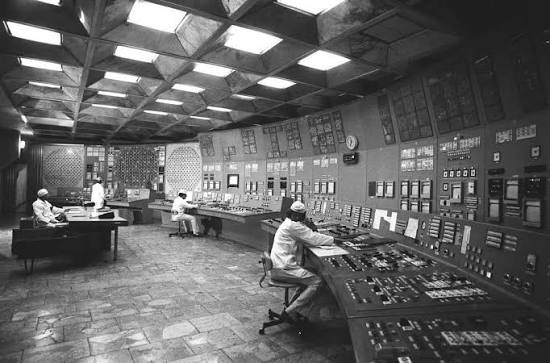
The first explosion was a steam explosion. It threw the reactor's upper shield — a steel plate weighing two thousand tonnes — into the air like the lid of a pot, and it came down standing on edge in the mouth of the crater. Two or three seconds later came a second, more violent blast, scattering burning graphite and nuclear fuel across the roofs of the plant and the yards below, and starting more than thirty fires at once.
From the crater rose a column of blue-violet light — ionised air glowing under the sheer intensity of the radiation. The residents of Pripyat, the sleeping city three kilometres away, saw it and thought it beautiful. Some came out onto their balconies; others stood on the railway bridge and watched, taking in with their own eyes what none of them knew was the most dangerous sight a human being can stand in front of.
Fire crews arrived within minutes, led by Lieutenant Volodymyr Pravik and Lieutenant Viktor Kibenok. They climbed onto the turbine hall roof to stop the fire spreading to neighbouring Reactor No. 3 — which they succeeded in doing, averting a far greater catastrophe.
But they were walking on lumps of radioactive graphite thrown out of the reactor core, with no radiological protection at all; some kicked the pieces aside or picked them up, wondering what they were. Survivors described a metallic taste in the mouth and a reddening of the face like sunburn — the early sign of a lethal dose.
Pravik and Kibenok both died on 11 May 1986 in Moscow's Hospital No. 6, after two weeks of suffering. Pravik was 23 years old, and had become a father only weeks earlier.
"3.6 roentgen — not great, not terrible"
Inside the plant, the problem was that nobody knew the real number. The dosimeters available to the shift topped out at 3.6 roentgen per hour; the high-range instruments were locked in a safe or out of order. So every reading came back the same: 3.6 — not because the radiation was 3.6, but because the needle had reached the end of its scale and stopped.
And even 3.6 R/h is not an innocent figure: it is roughly 36 millisieverts per hour, meaning a worker burns through their entire annual permitted dose in under an hour. The true value among the reactor debris reached about 15,000 roentgen per hour — four thousand times higher, a lethal dose in under two minutes.
That is why the reports going up to Moscow in the first hours insisted the reactor was intact and that a water tank had exploded. Workers were sent to pump water into a core that no longer existed. And the evacuation of Pripyat did not begin for 36 hours.
What kind of reactor was it — and what element did it run on?
It was a Soviet RBMK-1000, a design unlike anything built outside the Soviet Union, chosen chiefly because it was cheap, enormous, and ran on low-enriched uranium — that is, without the need for expensive enrichment plants.
| Component | Material | Role |
|---|---|---|
| Fuel | Uranium dioxide UO₂ — about 190 tonnes, enriched to only 2% uranium-235 | The source of fission and power |
| Moderator | Graphite (carbon) — about 1,700 tonnes of blocks | Slows neutrons so they can cause fission |
| Coolant | Ordinary water flowing through about 1,660 vertical pressure channels | Carries away heat and becomes the steam that drives the turbines |
| Control rods | Boron carbide — 211 rods | Absorb neutrons to slow or stop the reaction |
| Containment building | None | — |
That last line matters most. Western reactors are built inside a reinforced concrete containment dome designed to hold everything in if the core fails. The RBMK was so large that doming it would have been prohibitively expensive, so it made do with a steel upper shield. Which is why, when it exploded, there was nothing whatsoever between the reactor core and the sky over Europe.
Why did it explode? The full physics
The explosion was not nuclear in the atomic sense — no mushroom cloud, no nuclear blast wave. It was an enormous steam explosion caused by a sudden, runaway rise in reactor power. And that rise came from three phenomena acting together, any one of which could have been managed alone:
1) Xenon poisoning — the invisible enemy
Among the products of fission is an isotope called xenon-135, the greediest neutron absorber known (a cross-section of about 2.6 million barns). In normal operation it is produced and burned off by neutrons continuously, staying in balance. But when reactor power is suddenly reduced, it keeps being produced by the decay of iodine-135 while its burn-off stops — so it accumulates and strangles the reaction.
That is exactly what happened. Power fell to about 30 megawatts thermal (out of 3,200), and the reactor dropped into what is called the "xenon pit". The golden rule says: if you fall into the pit, shut the reactor down and wait a full day. But they wanted the test done, so they forced the power back up the only way possible: by withdrawing control rods.
And they withdrew them, and withdrew more. The rules required the equivalent of at least 30 rods to remain in the core as a safety reserve. At the moment of the explosion the equivalent inside was no more than six to eight. The reactor was running stripped of its ability to shut itself down.
2) The positive void coefficient — the original sin
In Western light-water reactors, the water is both moderator and coolant. If the water boils into steam, the reactor loses its moderator instantly and the reaction dies away by itself — free, physical safety.
In an RBMK the moderator is graphite, and the water is merely a coolant and a neutron absorber. So if the water boils into steam, the reactor does not lose its moderation (the graphite is still there) — it loses a neutron absorber. Power rises, so more water boils, so power rises further… a positive feedback loop that accelerates itself. This is the "positive void coefficient", and it is at its most dangerous at low power — precisely the state the reactor was in that night.
3) The graphite tips — the button that blew up the reactor
And here is the great irony of the whole story: the explosion began with the press of the shutdown button.
RBMK control rods were not solid boron. Beneath each rod hung a graphite displacer about 4.5 metres long, whose purpose was to keep water out of the channel while the rod was withdrawn. So if a rod was fully withdrawn and then driven down, graphite entered the core first — not boron.
Which means the first thing that happens on an emergency shutdown is that graphite displaces the absorbing water at the bottom of the core and replaces it with moderator — a local spike in reactivity in the lower core, before any boron arrives. This is the "positive scram effect". Under normal conditions it is a negligible transient. But in a reactor almost stripped of rods, full of steam, and in an unstable regime, it was like striking a match in a powder magazine.
Within a few seconds power leapt from about 200 megawatts to an estimated tens of thousands of megawatts — many times the design rating. The fuel shattered, steam burst the channels, and the shield plate was launched. The second explosion is still debated among scientists: a second steam blast, a hydrogen explosion from zirconium reacting with steam, or a criticality excursion in part of the core.
The moment of the explosion — a reconstruction of the final seconds
An important note: not a single genuine frame of the moment of the explosion exists anywhere in the world — no camera was filming the reactor at 01:23:44, and the earliest footage of the site was shot from a helicopter days later. Everything circulated as "video of the explosion" is either a dramatised scene from a work of fiction or a computer simulation. What you see above is an educational reconstruction built on the documented timeline, not a recording of the event.
The sequence — minute by minute
| Time | Event |
|---|---|
| 25 April — 01:06 | Power reduction begins in preparation for the test |
| 14:00 | Emergency core cooling system (ECCS) disconnected as part of the test procedure |
| 14:00 | The Kyiv grid controller asks for the shutdown to be delayed because the grid needs power — the reactor sits at half state for ten hours |
| 23:10 | Power reduction resumes — with a night shift that had not been trained for the test |
| 26 April — 00:28 | Power collapses to about 30 MW — the reactor falls into the xenon pit |
| 01:00 | Power forced back to 200 MW by withdrawing rods below the permitted limit |
| 01:23:04 | The test begins: steam cut off from the turbine, pumps slow, steam voids grow in the core |
| 01:23:40 | AZ-5 pressed — the rods descend, graphite tips first |
| 01:23:44 | First explosion — the 2,000-tonne upper shield is thrown clear |
| 01:23:47 | Second explosion — the hall is destroyed, graphite and fuel scattered |
| 01:28 | First fire crew arrives |
| 27 April — 14:00 | Pripyat is evacuated (49,360 people) by 1,200 buses — they were told: three days only |
| 28 April | Monitors at Sweden's Forsmark plant detect radiation on a worker's shoe — and the world finds out |
| 28 April — 21:00 | The first Soviet admission: a television statement lasting 20 seconds |
| 10 May | The graphite fire is extinguished after about ten days of continuous burning |
Negligence — an anatomy of the real causes
The first Soviet report in 1986 laid the blame entirely on the operators. But the IAEA's INSAG-7 report of 1992 inverted the picture: the primary cause was design deficiency, the second was safety culture — and the operators came third.
The suppressed report
The graphite-tip flaw had actually appeared at the Ignalina plant in Lithuania in 1983, and a warning report was written. It was classified and never reached plant operators. The Chernobyl crew pressed a shutdown button not knowing it could blow up their reactor.
An unreviewed test
The test programme was reviewed neither by the reactor's designer nor by the nuclear safety authority, and was never classified as "safety-related" — it was treated as a purely electrical experiment.
The ten-hour delay
The test was scheduled for daytime with the experienced shift. Postponing it handed the job to a night crew that had not prepared, and drove the reactor deep into xenon poisoning.
A hierarchy that forbade objection
Insistence on completing the test even after the reactor had left the required conditions, in an environment where a subordinate was not encouraged to say "stop".
No containment
The costliest design decision of all: with no dome, a local accident became the contamination of a continent.
A culture of secrecy
36 hours before evacuation, two days before telling the world, and May Day parades in Kyiv on 1 May beneath a radioactive plume.
Radiation — the numbers
The graphite fire burned for about ten days, lofting radionuclides to high altitude, and the winds carried them across Belarus, Ukraine and Russia and then over most of Europe.
| Quantity | Figure |
|---|---|
| Total activity released | about 14 × 10¹⁸ becquerel (14 EBq) |
| Iodine-131 released | about 1,760 petabecquerel — responsible for the thyroid cancers |
| Caesium-137 released | about 85 petabecquerel — responsible for the long-term contamination |
| Fraction of the core inventory released | noble gases ~100%, iodine ~50%, caesium ~30% |
| Area of Belarus contaminated | about 23% of the country — it alone received roughly 70% of the fallout |
| Dose rate at the debris | up to 15,000 roentgen/hour (≈150 Sv/h) — lethal in two minutes |
| Roof of Reactor No. 3 | up to 12,000 roentgen/hour — no soldier was allowed more than 40–90 seconds |
| The "Elephant's Foot" in the basement | a mass of molten corium, emitting about 10,000 roentgen/hour in 1986 |
A pine forest of about 10 square kilometres west of the reactor took a dose of roughly a hundred gray. Its trees died within days and turned a rust-red colour. The whole forest was bulldozed and buried in trenches in 1986, and the site remains among the most contaminated places on Earth.
The human cost — precise figures
Direct deaths
| Category | Number | Detail |
|---|---|---|
| Deaths on the night of the explosion | 2 | Valery Khodemchuk (pump operator — his body was never recovered and remains in the ruins) and Vladimir Shashenok (died at dawn of burns and injuries) |
| Diagnosed with acute radiation syndrome | 134 | Plant staff and firefighters — with doses between 0.8 and 16 gray |
| Deaths in the first three months | 28 | From acute radiation syndrome and extensive beta burns of the skin — in many cases those burns were the actual cause of death |
| Official direct toll | ≈ 30 | The figure used by the UN's UNSCEAR committee |
| Later deaths among ARS survivors | 19 | Between 1987 and 2004 from various causes, not all attributable to radiation |
Thyroid cancer — the scientifically established effect
The only statistically confirmed health effect in the general population is a rise in thyroid cancer among those who were children and adolescents at the time. The mechanism is precise: iodine-131 fell on pasture, cows ate it, it passed into milk, and children drank it — and the thyroid hoards iodine, while a child's gland is small, so the dose concentrates.
- About 20,000 cases of thyroid cancer were diagnosed between 1991 and 2015 among those who were under 18 in 1986, across Belarus, Ukraine and Russia.
- Survival for this cancer is very high, so only about 15 deaths within that group are attributed to it.
- Most of these cases were preventable by banning local milk and distributing stable iodine tablets — which is what Poland did within days (some 18 million doses), and Poland saw no appreciable increase.
Liquidators and the displaced
≈ 600,000
People granted the status of "liquidator" in total. The core group (about 240,000 in 1986–1987) received an average dose of around 100 millisieverts.
49,360
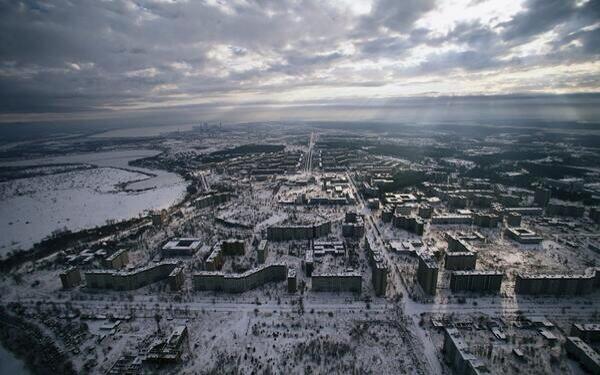
Residents of Pripyat, evacuated on 27 April — not one of them ever returned home.
≈ 116,000
Evacuated from the 30-km zone during 1986.
≈ 220,000
Resettled in later years — bringing the total displaced to roughly 350,000.
This is the most disputed number in the history of radiation medicine, because a cancer caused by a low dose carries no signature distinguishing it from an ordinary one, and the expected excess is smaller than the natural fluctuation across a population of tens of millions.
The Chernobyl Forum (WHO, the IAEA and the UN, 2005–2006) estimated an eventual toll of about 4,000 among the most exposed groups, and the World Health Organization extended this to roughly 9,000 across a wider region. Some unofficial estimates put the figure in the tens of thousands using different and contested methodologies.
The Forum also reached one striking conclusion: that the psychological and social impact — anxiety, depression, stigma and a sense of helplessness — was the single largest public health problem the disaster produced, greater than the direct radiological effect on the general population.
The battle — how the disaster was stopped
Bombardment from the air
Between 27 April and 10 May, Mi-8 and Mi-26 helicopters dropped about 5,000 tonnes of sand, clay, dolomite, boron carbide (to absorb neutrons) and 2,400 tonnes of lead (for shielding) into the crater. The pilots flew over a mouth emitting a lethal dose on every pass. Later studies showed that much of the load never hit the opening at all.
The three divers
Beneath the reactor were large bubbler pools full of water. Had molten fuel reached them, the result would have been an enormous steam explosion. On 4 May 1986 three men — Alexei Ananenko, Valeri Bespalov and Boris Baranov — went down into the flooded, pitch-dark basements, opened the valves and drained the water.
Contrary to the popular myth that they died within days, all three survived. Baranov died of a heart attack in 2005, and the other two were decorated by Ukraine in 2018, still living.
The miners
Fearing that molten fuel would burn through the concrete foundation and reach the groundwater, about 400 coal miners were brought from Tula and the Donbas. In a month they dug a 150-metre tunnel beneath the reactor to install a heat exchanger, working in temperatures near 50°C, many of them nearly naked because clothing was unbearable. The heat exchanger was, in the end, never used.
The "bio-robots"
Remote machines failed on the roof of Reactor No. 3: intense radiation destroys electronics by damaging semiconductors, so the machines stalled or behaved erratically. They were replaced by about 3,828 soldiers, wryly nicknamed the "bio-robots": each man wore a lead apron, went up to hurl a few blocks of graphite off the roof within 40 to 90 seconds, came down — and never went up again.
The sarcophagus, then the arch
- The "Sarcophagus" (1986): built between May and November 1986 using 400,000 m³ of concrete and 7,300 tonnes of steel, completed on 30 November 1986. It was designed to last about 30 years, and began to corrode and leak.
- The "New Safe Confinement" (2016): a giant steel arch 108 metres high with a 257-metre span, weighing some 36,000 tonnes. Built to one side and then slid on rails over the old sarcophagus in November 2016, formally handed over in 2019. It cost around €2 billion, contributed by some 45 countries, and has a design life of 100 years.
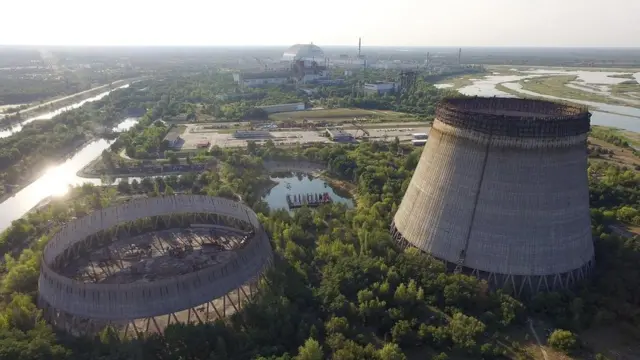
Despite the disaster, Chernobyl's other reactors went on generating electricity for years, because Ukraine badly needed the power. Reactor 2 was shut down in 1991 after a fire, Reactor 1 in 1996, and Reactor 3 — directly adjoining the exploded unit — ran until 15 December 2000. Which means workers reported for duty for fourteen years, metres away from the most dangerous ruin in the world.
How long will the city stay off limits?
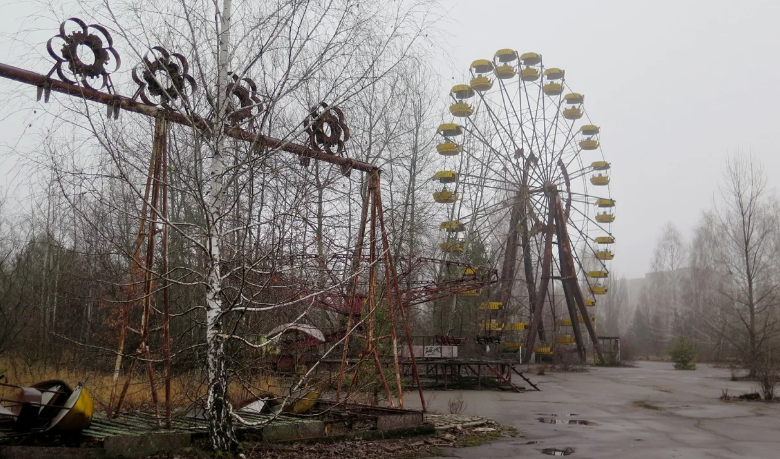
There is no single answer, because it depends on which isotope and which patch of ground. Today's Exclusion Zone is roughly a 30-km radius covering about 2,600 km² on the Ukrainian side, adjoined in Belarus by the Polesie radioecological reserve.
| Isotope | Half-life | When does it stop mattering? |
|---|---|---|
| Iodine-131 | 8 days | Long gone within months of the accident — but it did its damage in the first weeks |
| Caesium-137 | 30.2 years | The dominant hazard today — needs about 300 years to fall to a thousandth |
| Strontium-90 | 28.8 years | Much like caesium — and chemically like calcium, so it lodges in bone |
| Americium-241 | 432 years | Currently increasing, because it is produced by the decay of plutonium-241; it peaks around 2060 |
| Plutonium-239 | 24,100 years | This is what keeps the ground nearest the reactor off limits for thousands of years |
The answer, at three levels:
- Most of the Exclusion Zone, and Pripyat itself: estimated fit for permanent habitation in roughly 300 years — around the year 2300 — once caesium and strontium have decayed to acceptable levels.
- The most contaminated patches (the Red Forest and the few square kilometres around the reactor): estimated at between 3,000 and 20,000 years, because of plutonium and americium.
- The reactor site itself: effectively unusable for ordinary purposes for the foreseeable future; the official plan is to dismantle the ruins gradually over decades beneath the new arch.
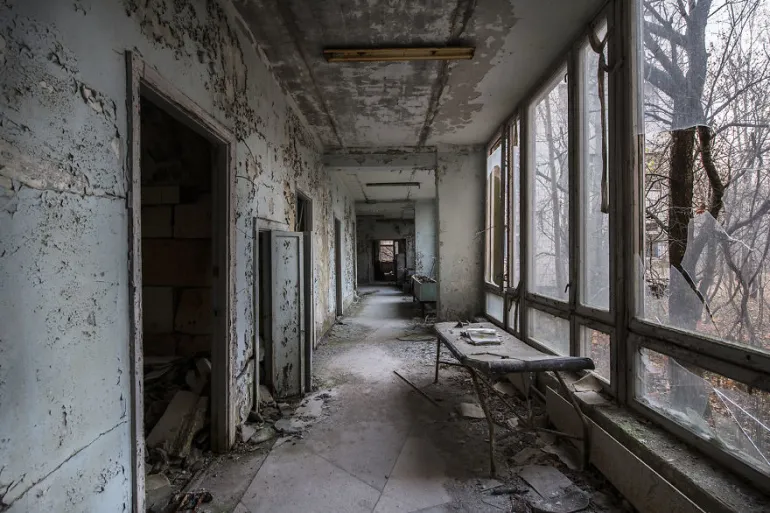
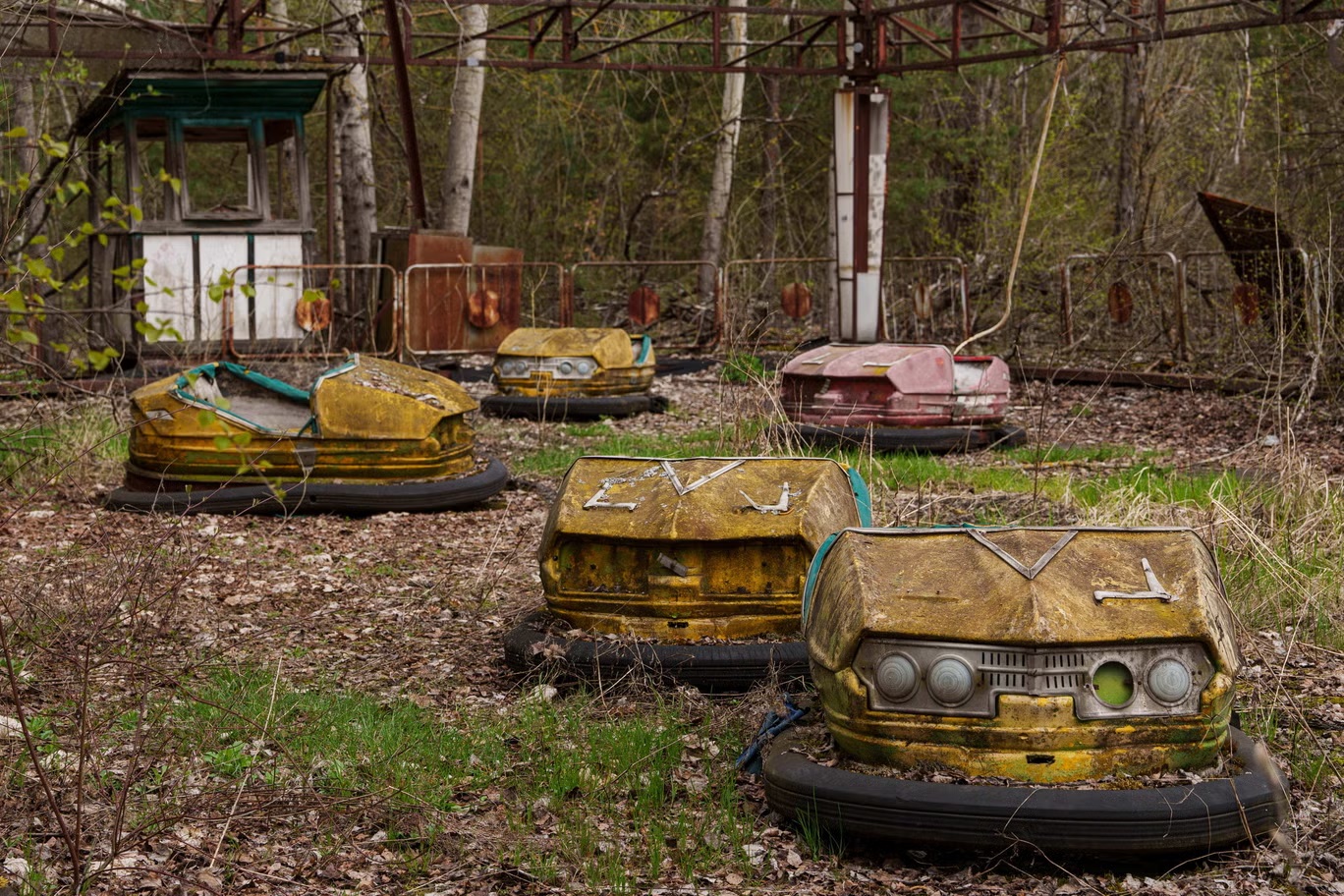
Even so, the zone is no longer dead ground. It was declared a radiological biosphere reserve in 2016, rare wildlife has flourished there (wolves, wild horses, lynx) because the absence of humans turned out to weigh less on them than the radiation does, and a solar power station was built there in 2018 on land good for nothing else.
Preventive measures learned — what changed in the world
1) Fixing the reactors themselves
- Fuel enrichment raised from 2% to 2.4% and higher, with fixed absorbers added — which sharply reduced the positive void coefficient.
- Control rods redesigned to eliminate the "positive scram effect" entirely.
- Emergency shutdown made far faster (it had taken some 18–21 seconds!), and a hard minimum number of rods in the core that operators cannot override.
- A containment building adopted as a basic requirement of every new design worldwide.
2) The concept of "safety culture"
The term itself — safety culture — entered the global engineering vocabulary because of Chernobyl (the INSAG-4 report, 1991). Its meaning is that safety is not a checklist to be signed but an institutional behaviour: that the most junior operator has the standing to say "stop" and everything stops, and that nobody is rewarded for cutting through procedure to hit a target faster.
3) Immediate notification instead of secrecy
It was the Soviet Union's two full days of silence that drove the world to adopt the Convention on Early Notification of a Nuclear Accident and the Convention on Assistance on 26 September 1986 — just five months later. A state is now legally obliged to notify the IAEA and its neighbours immediately.
4) Independent regulation and peer review
- The founding of WANO — the World Association of Nuclear Operators — in 1989, which subjects every plant on Earth to periodic peer review across political lines.
- The Convention on Nuclear Safety in 1994, and the separation of the regulator from the body promoting nuclear power — a lesson Fukushima reaffirmed in 2011.
5) A common global scale for nuclear events
The INES scale was created in 1990 to rate nuclear events from 0 to 7. Chernobyl is rated Level 7 — "major accident", the top of the scale. Only one other event in history has reached it: Fukushima, 2011.
6) Emergency planning and protecting the public
- Stable iodine tablets pre-stocked near every plant, to be distributed within hours so the thyroid is saturated and cannot take up radioactive iodine.
- Pre-defined evacuation planning zones with maps, routes and buses — no improvising after the event.
- Food-chain monitoring: immediate bans on local milk and vegetables — the measure that would have prevented tens of thousands of cases in 1986.
- Full-scope training simulators and mandatory operator licensing, and a prohibition on any test of an operating reactor without independent review by the designer and the regulator.
Plant director Viktor Bryukhanov, chief engineer Nikolai Fomin and his deputy Anatoly Dyatlov were tried in 1987 and each sentenced to ten years. And Valery Legasov, the scientist who led the Soviet delegation to Vienna and laid a detailed account of the accident before the world, recorded tapes describing the true causes and the suppressed design flaws — then took his own life on 26 April 1988, the second anniversary of the explosion, to the day.
Conclusion
Chernobyl did not explode because physics betrayed anyone. Physics did what it always does: a positive void coefficient means steam raises power; accumulated xenon means the reaction is choked; graphite entering the core means a reactivity spike. Every equation performed its duty exactly that night.
What collapsed was something else: a chain of human decisions, each of which looked reasonable on its own. A report classified so that nobody would be embarrassed. A test delayed ten hours because the grid needed power. A rule broken because it had been broken before without harm. A containment building cancelled because it was expensive. And a number written down on an instrument because the instrument could not display anything larger.
That is why Chernobyl's significance is not measured only in casualties. It proved that the most dangerous thing in any technical system is not its reactor, but the distance between what the designers know and what the operators know. Every convention, scale, peer review and stockpile of iodine tablets built since then is one repeated attempt to close that distance — before someone presses a red button again, not knowing what will happen.