Absolute Zero — Taming the Cold
Open the freezer door
Your kitchen freezer reaches −18 °C. The coldest temperature ever recorded on Earth's surface was at Vostok Station in Antarctica: −89.2 °C. The surface of Pluto sits at roughly −230 °C. And intergalactic space — the black emptiness with nothing in it at all — settles at −270.4 °C.
Notice what is happening: the numbers are bunching up. The colder the place, the smaller the steps between them. As though there were a wall down there that the entire universe — with all its galaxies and nebulae and vacuum — is unable to break through.
That wall is real, and we know its value to two decimal places:
−273.15 °C
= 0 kelvin = −459.67 °F
The strange part of the story is that humanity knew this number two full centuries before getting anywhere near it. Nobody measured it; no instrument reached it. It was deduced from a straight line on a graph — a ruler laid down, the line extended forward until it touched the axis. And when scientists finally built real cooling machines, they found nature waiting for them at exactly the same number.
Why does cold have a floor when heat has no ceiling?
The question sounds odd: why should cold be bounded and heat unbounded? The answer starts with understanding what heat actually is.
Temperature is not a substance that flows into an object and out of it — though scientists believed exactly that for a century and gave it a name, caloric. Temperature is a measure of the average random kinetic energy of an object's atoms and molecules: how much they vibrate, rotate and collide.
And that is where the asymmetry comes from. To heat something, you give its atoms more energy of motion — and there is no upper limit on how much energy you can supply. To cool it, you remove energy of motion. Once you reach the state where there is nothing left to remove — the lowest energy the system can have — what would you take away next? An atom cannot move slower than "not at all".
The popular description "at absolute zero atoms stop moving completely" is simply wrong — a leftover from classical physics, from before quantum mechanics.
Heisenberg's uncertainty principle forbids a particle from having a perfectly defined position and exactly zero momentum at the same time. So even at absolute zero a particle retains an irreducible amount of motion, called zero-point energy. Absolute zero is therefore not "motion stops"; it is the lowest energy state quantum law permits — and that is not zero.
This energy has a consequence you can see with your own eyes: helium never freezes at ordinary atmospheric pressure, no matter how cold it gets. The zero-point jiggling of its light atoms is stronger than the forces binding them, so it stays liquid all the way down to zero kelvin. To force it to solidify you must squeeze it to about 25 atmospheres. Helium is the only substance in nature that behaves this way.
How did we find the number before we could reach it? — gases point the way
At the end of the eighteenth century, European scientists were obsessed with gases: hot-air balloons were rising into the sky and the new chemistry was discovering oxygen and hydrogen. In that climate, around 1787, the French physicist Jacques Charles noticed a simple and startling relationship:
If you hold a gas at constant pressure, its volume grows by a fixed amount for every degree you raise its temperature.
Charles never published his results. Joseph Louis Gay-Lussac published them in 1802, credited Charles honestly, and measured the coefficient more precisely. The result was that any gas — air, oxygen or hydrogen alike — expands by close to 1/273 of its volume at 0 °C for each degree. In other words:
V = V₀ ( 1 + t / 273.15 )
where V₀ is the gas volume at 0 °C and t its temperature in degrees Celsius.
Now ask the question those scientists asked: what if the cooling carried on? The volume shrinks with every degree — so when does it reach zero?
Straight from the equation: when 1 + t/273.15 = 0, that is, at t = −273.15 °C.
And this was more than algebra. The beautiful part is that you can run the experiment with different gases, in different quantities, at different pressures — and you get straight lines with completely different slopes. Then you extend each of them to the left… and they all meet at one single point. That cannot be a coincidence. The point is not a property of oxygen, or of hydrogen, or of how much gas you used; it is a property of temperature itself.
Run the simulation below to watch it happen:
Extrapolating Charles's law — deducing absolute zero from a sheet of graph paper
An honest caveat: no gas in nature stays a gas down to −273 °C; every one of them turns liquid and then solid long before (oxygen at −183, hydrogen at −253). So only the solid part of each line is actually measured, and everything beyond it is mathematical extrapolation. The strength of the conclusion does not come from any one line, but from the fact that every line, whatever its slope, points at the same spot.
Eighty years before Charles, in 1702, the Frenchman Guillaume Amontons noticed that the pressure of trapped air fell steadily as it cooled, and wrote that there must be an "extreme degree of cold" at which air pressure would reach zero — which he put at about −240 °C. His instruments were crude, but he was the first to say that cold has an end.
Then the German Johann Lambert came closer still in 1779, estimating about −270 °C. Three centuries of refinement, with the number creeping towards its true home.
Where did our degrees come from? — the story of the scales
To build a temperature scale you need only two things: two fixed points that anyone anywhere can reproduce, and then a division of the gap between them into equal parts. The rest is convention.
Why water in particular?
Choosing water was not arbitrary nor sentimental. It met conditions nothing else met at the time:
- It is everywhere — a researcher in Cairo or in Stockholm does not need to import a rare substance to calibrate an instrument.
- It has two sharp phase transitions — freezing and boiling. And during a phase change the temperature holds perfectly steady even while you keep heating the vessel, because the energy goes into breaking bonds rather than raising the temperature. That is exactly what makes a point genuinely "fixed" and reproducible.
- The gap between them is convenient — it covers most of the temperatures a human being encounters in ordinary life.
Three men, three scales
| Scale | Author and year | How it was defined | Water freezes / boils |
|---|---|---|---|
| Fahrenheit °F | Daniel Fahrenheit — 1724 | His zero was the temperature of a brine of ice, water and ammonium chloride (the coldest he could produce); 96 was roughly human body temperature | 32 and 212 — that is 180 degrees apart |
| Celsius °C | Anders Celsius — 1742 | Divided the interval between the freezing and boiling of water into 100 parts — hence "centigrade" | 0 and 100 |
| Kelvin K | William Thomson (Lord Kelvin) — 1848 | An absolute scale: its zero is absolute zero itself, and one kelvin is exactly the same size as one degree Celsius | 273.15 and 373.15 |
In Anders Celsius's original 1742 version, 0 was the boiling point and 100 the freezing point — the number grew as it got colder! He was studying snow and ice and wanted positive, rising numbers for deeper cold. The scale was flipped into the form we know about two years after his death, a step usually credited to Carl Linnaeus and to the instrument maker Daniel Ekström.
The flaw that eventually retired water
The water definition carried a hidden defect that surfaced as precision improved: the boiling point depends on pressure. On the summit of Everest water boils at about 70 °C; in a pressure cooker it passes 120 °C. The purity of the water shifts both points too, as does dissolved air.
So international agreements gradually abandoned boiling and adopted, in 1954, a far more precise anchor: the triple point of water — the single state in which ice, liquid water and vapour coexist in equilibrium, with a pressure and temperature entirely of its own — fixed at exactly 273.16 kelvin.
On 20 May 2019 the whole International System of Units was redefined to rest on constants of nature instead of objects and substances. The kelvin is now defined by fixing the Boltzmann constant at:
k = 1.380649 × 10⁻²³ J/K
Which means temperature is now defined directly in terms of energy — each kelvin corresponds to a specific amount of particle kinetic energy. Water plays no part in the definition any more, and 273.16 K has become an experimentally measured value rather than an imposed one. But note: absolute zero never moved. It is not a human convention but a physical limit.
The ladder of cold — where do we stand relative to the floor?
How far has humanity got? — the cooling race
The history of cold is the history of a race to liquefy gases. Every gas you manage to liquefy becomes your tool for cooling the next one down, and so you descend rung by rung.
| Year | Achievement | Limit reached |
|---|---|---|
| 1877 | Cailletet and Pictet liquefy oxygen | 90 K |
| 1883 | Wróblewski and Olszewski liquefy nitrogen in useful quantities | 77 K |
| 1898 | James Dewar liquefies hydrogen — and also invents the Dewar flask (the thermos!) that made storing cold liquids possible at all | 20 K |
| 1908 | Heike Kamerlingh Onnes at Leiden liquefies helium — the last gas to hold out | 4.2 K |
| 1911 | Onnes measures the resistance of mercury at 4.2 K and finds it drops to zero — superconductivity discovered by accident | — |
| 1933 | Giauque and MacDougall: adiabatic demagnetisation breaks the one-kelvin barrier | 0.25 K |
| 1965 | The first working dilution refrigerator, using a helium-3/helium-4 mixture — continuous cooling, not a fleeting pulse | ≈ 10 mK |
| 1980s | Laser cooling (Chu, Cohen-Tannoudji, Phillips — Nobel 1997): slowing atoms with light itself | microkelvin |
| 1995 | Cornell and Wieman create the first Bose–Einstein condensate from rubidium atoms | 170 nK |
| 1999 | Rhodium nuclei in Helsinki — the coldest solid matter ever | 100 pK |
| 2021 | An atom cloud expanded in weightlessness inside the Bremen drop tower | 38 pK |
How do you cool atoms with light?
It sounds like a contradiction: lasers heat steel and cut metal — how can one cool anything? The trick lies in tuning the frequency. You aim at the atom a laser whose frequency is slightly below the one it absorbs. A stationary atom does not see it and does not absorb. But an atom moving towards the laser sees that light shifted up in frequency (the Doppler effect) and does absorb it — receiving with every photon a kick opposite to its direction of travel.
The atom then re-emits the photon, but in a random direction, so the emission kicks average out to nothing while the absorption kicks all pile up in one direction: the atom slows down. Fire six beams from six sides and the atom finds itself in a viscous bath of light it cannot escape — physicists call it optical molasses.
Then comes the final step: evaporative cooling. It is the same trick a cup of tea performs — the rim of the magnetic trap is lowered bit by bit so the highest-energy atoms escape and the coldest remain. You lose 99% of your atoms, but what is left drops into the nanokelvin range.
Why can we never reach absolute zero?
This is not a temporary engineering failure waiting for a better machine. It is a law of nature, formulated by Walther Nernst in 1906 and known as the third law of thermodynamics. It has a decisive form:
It is impossible to cool any system to absolute zero in a finite number of steps, in a finite time.
The impossibility has four faces, and any one of them alone is enough:
1) The halving rule
Every cooling method removes a fraction of the remaining heat, not a fixed amount. Remove half each cycle and after ten cycles you are at 1/1024 — and you will never reach zero however long you repeat. And the closer you get, the costlier and slower each step becomes, as the heat capacity itself vanishes and removing the last sliver becomes a titanic job.
2) Zero-point energy
The uncertainty principle forbids perfect stillness. Even in the lowest state quantum law allows, a particle keeps a vibration of ½ ħω that no machine can strip away — because it is not "heat" at all, but a feature woven into reality.
3) Heat leaks
Your sample is not alone in the universe. Every measurement wire conducts heat, every wall radiates photons, every vibration in the building ends up as energy in the sample. And the act of measuring itself pumps energy into what you are measuring.
4) The universe's own floor
The universe is bathed in the cosmic microwave background at 2.725 K — leftover heat from the Big Bang. Any exposed object in the remotest corner of space settles at that temperature. Going below it never happens spontaneously in nature; it is a purely artificial act, and the coldest places in the entire cosmos are our laboratories.
And yet getting close is enormously useful. The difference between 10 millikelvin and zero means nothing practical to a quantum computer; what matters is that the thermal energy be far smaller than the energy you are trying to control. We do not need zero. We need close enough.
What happens to matter down there?
This is where the story gets genuinely exciting. Extreme cold is not simply "the same thing but slower". At certain thresholds the rules of the game change, and behaviours appear that have no counterpart whatsoever in our warm world.
The reason is the same in every case: at ordinary temperatures, thermal chaos smears out and drowns quantum phenomena, like noise swallowing a whisper. Remove the noise, and quantum mechanics shows up at a scale you can see.
1) Superconductivity — electricity without resistance
On 8 April 1911, Onnes was measuring the resistance of a mercury wire while cooling it with the liquid helium he had produced three years earlier. At 4.15 kelvin the resistance did not fall gradually as he expected; it vanished. He noted in his logbook: resistance practically zero.
And "zero" here means genuinely zero, not "very small". In experiments where a current was launched around a superconducting loop, it kept circulating for years with no measurable decay. Calculations put its decay time at longer than the age of the universe.
Electrical resistance comes from electrons scattering off vibrations of the crystal lattice, losing their energy as heat. Explaining its disappearance took 46 years, until Bardeen, Cooper and Schrieffer published their theory in 1957.
The idea: a passing electron pulls the positive lattice ions slightly towards itself, leaving behind a region of positive charge that attracts a second electron. The result is an indirect attraction between two particles that repel each other, binding them into a Cooper pair. This attraction is extraordinarily feeble — which is why heat destroys it instantly, and why it only appears in deep cold.
The key is that the pair as a whole behaves as a boson, not a fermion, and bosons are allowed to occupy the same quantum state all together. So millions of pairs collapse into a single coherent quantum state that moves as one entity. Obstructing that current would require exciting the whole state at once across an energy gap — and a single lattice vibration does not carry nearly enough. So the pairs sail through without scattering off anything: zero resistance.
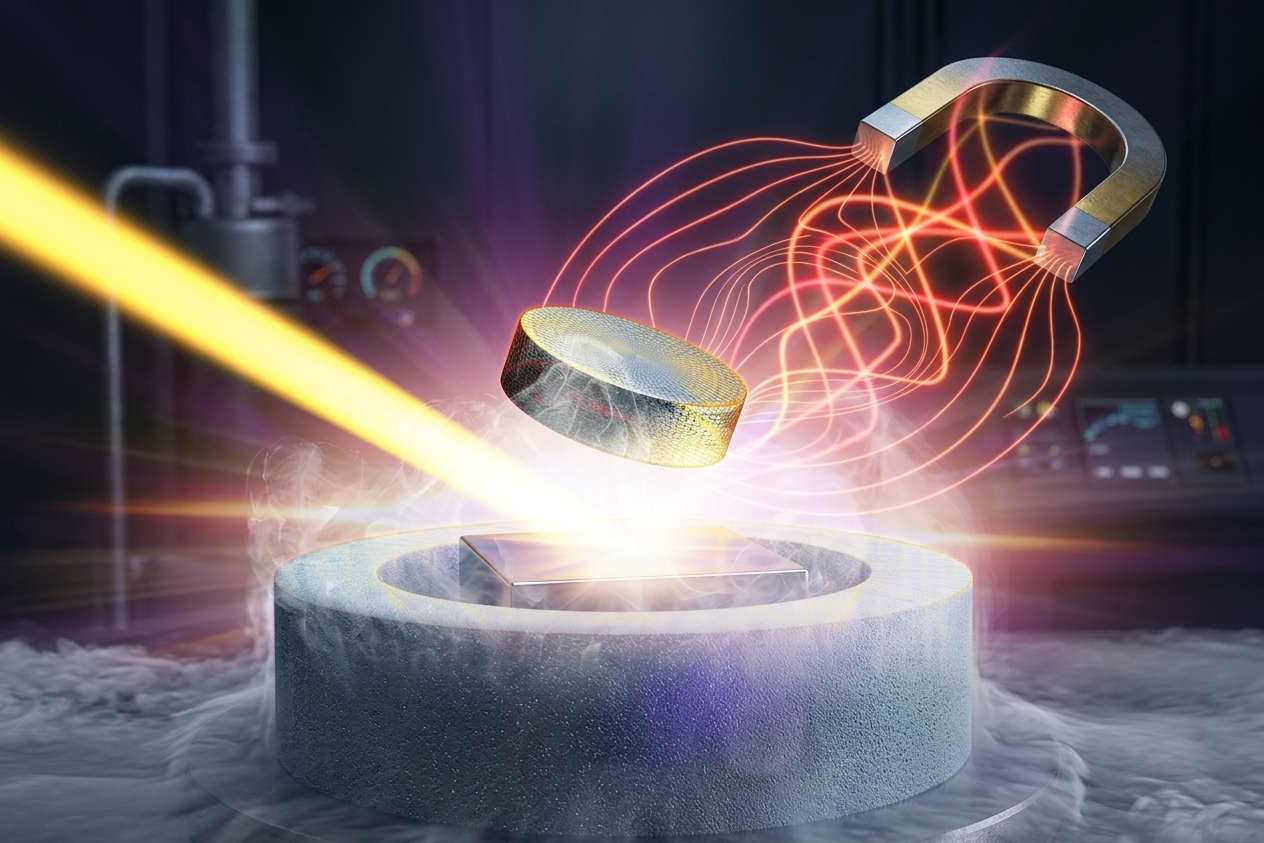
The Meissner effect — the secret of the photo at the top of this article
In 1933 Meissner and Ochsenfeld discovered that a superconductor does something stranger still than abolishing resistance: it expels magnetic field from its interior completely. Persistent currents form on its surface, generating an opposing field that cancels the external one entirely inside the material.
That is why a magnet floats above it: the material refuses the field, so it pushes the field's source away. And in type-II superconductors something lovelier happens — the field penetrates in fine threads called vortices whose positions get anchored on defects in the crystal, so the disc becomes locked in space rather than merely floating: turn the whole thing upside down and it stays "hanging" beneath the magnet. This is flux pinning, and it is what makes magnetic levitation trains possible.
The race to raise the critical temperature
| Material | Critical temperature | What it means in practice |
|---|---|---|
| Mercury (1911) | 4.2 K | The first ever found — needs expensive liquid helium |
| Niobium-titanium alloy NbTi | 9.2 K | The industrial workhorse — MRI magnets and colliders |
| Nb₃Sn | 18 K | Stronger fields — the magnets of the ITER fusion reactor |
| LaBaCuO (1986) | 35 K | Bednorz and Müller open the era of the cuprates — a Nobel just one year later! |
| YBCO (1987) | 92 K | The golden barrier: above 77 K, meaning cheap liquid nitrogen suffices instead of helium |
| HgBaCaCuO | 133 K | The highest stable figure at ordinary atmospheric pressure |
| H₃S at 155 GPa | 203 K | Compressed hydrides — a pressure equal to half that at the Earth's core |
| LaH₁₀ under immense pressure | ≈ 250 K | Only −23 °C! But the pressure required makes it practically useless |
The grand prize the world has chased for forty years is a superconductor that works at room temperature and ordinary pressure. If it arrived, civilisation would change: power grids with no losses (today we lose roughly 5–8% of all the world's electricity just moving it), tiny motors of enormous power, computers that never get hot. It has been announced more than once — but the most prominent of those announcements had their papers retracted after other groups failed to reproduce the results, a reminder that science rests on replication, not on press releases.
2) Superfluidity — a liquid that climbs walls
Cool liquid helium-4 below 2.17 kelvin (the lambda point) and something worth watching happens. It was discovered in 1938 simultaneously by Pyotr Kapitsa in Moscow and Allen and Misener in Cambridge:
- Zero viscosity. The liquid flows through cracks narrower than a micrometre with no friction at all. Put it in a rotating vessel and it stays still while the vessel turns around it.
- It climbs the wall of its container and escapes. It creeps over surfaces in a film tens of atoms thick (the Rollin film), up the inside wall, down the outside, and drips off the bottom. An open beaker of superfluid helium empties itself.
- The fountain effect. Warm one part of it slightly and it shoots from a narrow nozzle in a jet centimetres high — heat converted directly into motion.
- It suddenly stops boiling. Above the lambda point it bubbles violently; below it the surface goes perfectly still, like a mirror, because its thermal conductivity becomes hundreds of times better than copper, so no hot spots form for bubbles to nucleate on.
The underlying reason is the same: a helium-4 atom is a boson, and at this temperature a large fraction of the liquid drops into the same ground state and behaves as a single liquid with no internal friction.
Helium-3, by contrast, has an atom that is a fermion, and fermions are forbidden from sharing a state. So superfluidity looked impossible for it — until Osheroff, Richardson and Lee discovered in 1972 that it does exactly that at around 2.5 millikelvin, a thousand times colder. The reason? Its atoms pair up just as Cooper's electrons do, and the pairs are bosons. The same trick on a different stage — and a Nobel in 1996.
Bose–Einstein condensation — the fifth state of matter
In 1924 the Indian physicist Satyendra Nath Bose sent a paper to Albert Einstein after journals had rejected it. Einstein was impressed, translated it himself and had it published — then pushed it further: what if Bose's statistics were applied to atoms with mass, not just to photons?
Out came a strange prediction: below a critical temperature, a large fraction of the atoms will drop all at once into the lowest possible energy state — and stay there. They do not spread across the available states as they always do; they pile into a single one.
The idea in one line
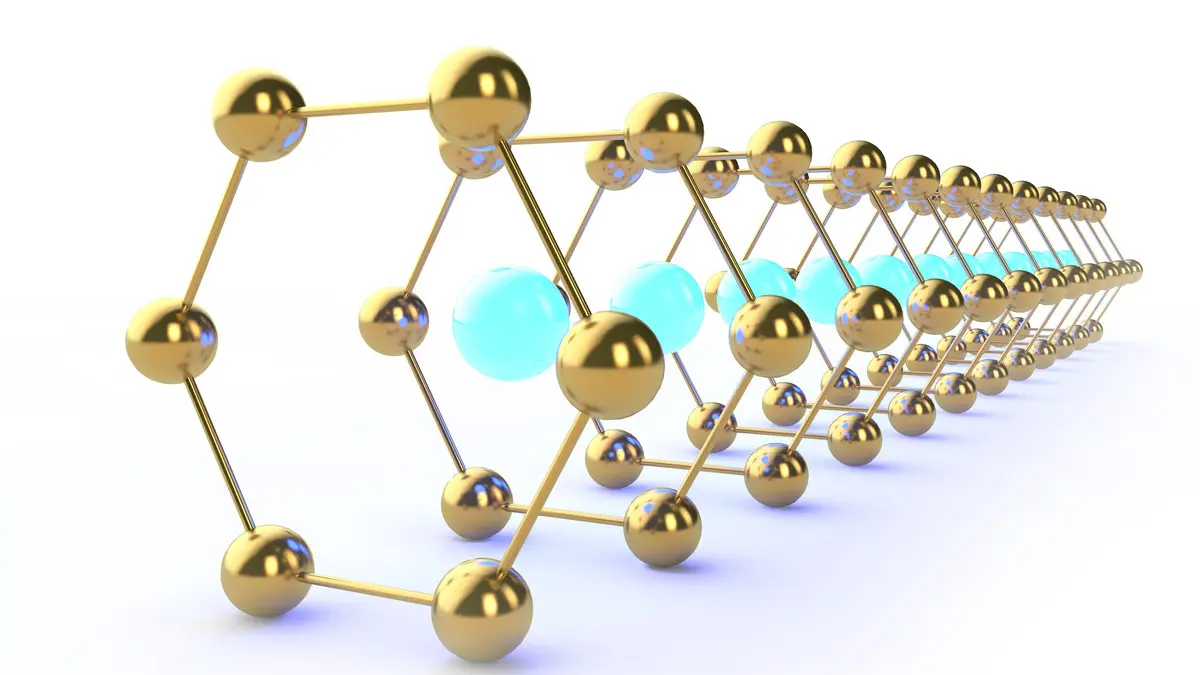
Every moving particle has a de Broglie wavelength, inversely proportional to its speed. Cool the atoms and they slow; slow them and their waves swell. Keep cooling until each wave is longer than the distance to the neighbouring atom — and the waves overlap and merge, so that saying "this is one atom and that is another" no longer means anything.
At that point millions of atoms fuse into a single wavefunction: an object with the properties of one particle but at a size you can photograph. Physicists call it a "super-atom", and it counts as the fifth state of matter after solid, liquid, gas and plasma.
At the JILA laboratory in Colorado, Eric Cornell and Carl Wieman cooled about 2,000 rubidium-87 atoms to 170 nanokelvin — 0.00000017 of a degree above absolute zero. A sharp spike appeared on the screen in the velocity distribution: all those atoms moving at the same speed, in the same state.
Months later Wolfgang Ketterle at MIT achieved it with sodium atoms in far greater numbers, and demonstrated two condensates interfering like two waves. The three shared the 2001 Nobel Prize. A prediction Einstein wrote on paper in 1925 had become something you could manufacture in a laboratory — seventy years later.
And why does it matter?
- Slowing and stopping light. In 1999 Lene Hau slowed a light pulse inside a sodium condensate to 17 metres per second — slower than a bicycle. In 2001 she stopped it altogether, stored it in the atoms, and released it again. This is the foundation of the idea of quantum memory.
- The most sensitive instruments there are. Atom interferometers built on cold atoms detect minute variations in gravity — used to find groundwater and underground cavities without digging.
- Atomic clocks. A cold atom lingers longer in the measurement region, so its frequency can be read more precisely. Today's optical lattice clocks would lose less than a second over the age of the universe — and on them rest GPS, telecommunications and power grids.
- Simulating matter. Cold atoms are trapped in a lattice of light that mimics a real crystal, letting physicists study phenomena that are computationally unsolvable — a tunable miniature model of superconductors themselves.
Quantum computers — why do they live in a refrigerator?
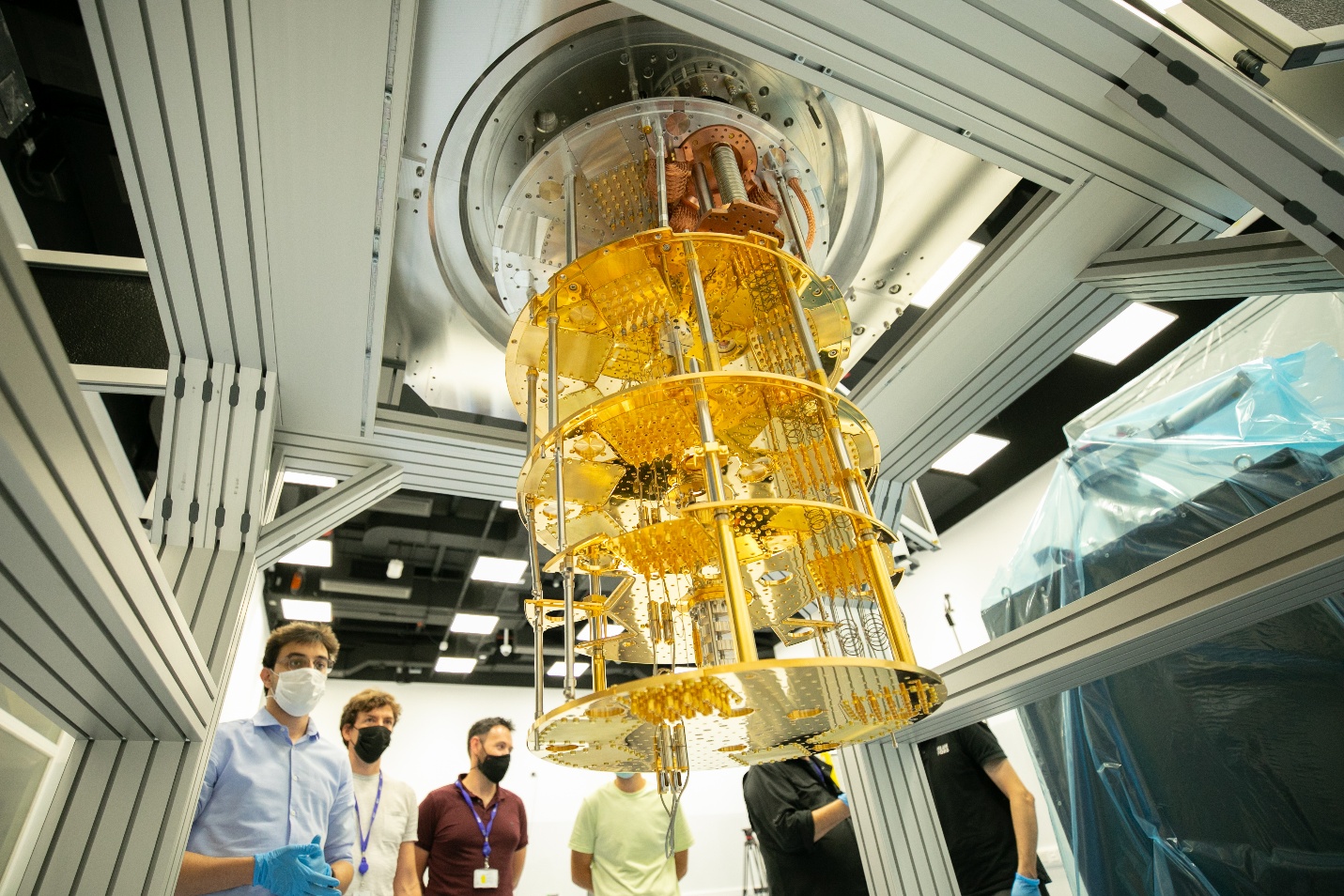
This image has become an icon of our era. But why go to all that trouble? The answer is three words: heat destroys information.
The qubit — and what "in two places at once" actually means
An ordinary bit is either 0 or 1, with no third option. A qubit can be in a superposition of both: a single mathematical state carrying a share of each.
People often say an electron "exists in two places at the same time". It would be more accurate to say: the electron is in a single state that has no classical counterpart. It is not "here", it is not "there", and it is not "half here and half there" — it is a third thing for which human language has no word, because our senses were never built to see it.
The evidence for it is not direct observation (any measurement forces it to choose) but interference: patterns that appear and can only be explained by both "possibilities" having travelled through together and interacted. And that interference — not "parallelism" — is where the real power of quantum computing comes from.
In superconducting computers the qubit is not a lone electron but a tiny electrical circuit containing a Josephson junction. Thanks to superconductivity, billions of Cooper pairs in that circuit behave as one single quantum entity, so the circuit can be in a superposition of two currents flowing in opposite directions at once. This is a quantum phenomenon at a scale visible under an optical microscope — and it is possible only because the material is superconducting.
A small calculation that explains everything
A typical superconducting qubit has a frequency of about 5 GHz. Convert its energy into the temperature that corresponds to it (divide hf by k) and you get roughly 0.24 kelvin = 240 millikelvin.
So if you ran the chip at 240 millikelvin, thermal noise would be as strong as the signal: the environment would flip qubit states at random and erase the computation. At 10 millikelvin, the thermal energy is twenty-four times smaller than the qubit gap, and the chance of heat exciting it at random falls below one in ten billion. Only then can you compute.
On top of that, superconductivity itself is a design requirement: without resistance there is no wasted power to heat the chip and disturb it. Cold is not a luxury here — it is what makes the device a device.
Even so, decoherence remains the primary enemy: a qubit state survives only tens to hundreds of microseconds before the environment swallows it. That is why most quantum computing research today revolves around quantum error correction: using thousands of fragile physical qubits to build one reliable logical qubit.
Temperature and technology — in both directions
Before we get to the applications of cold, it is only fair to see how far temperature — high and low alike — is the first constraint on everything we build.
When the temperature rises
- Electronics: leakage current in a transistor roughly doubles for every 10 °C rise, and junctions degrade faster. That is why your phone's processor lowers its own clock speed when it gets hot (throttling).
- Data centres: somewhere between a third and 40% of their power goes to cooling alone rather than to computing. Hence the ones built in Iceland and northern Sweden, and the experimental ones sunk to the seabed.
- Batteries: the Arrhenius rule says chemical reaction rates double for every 10 °C. So a lithium battery ages far faster in a hot climate.
- Jet engines: the gas entering the turbine exceeds 1700 °C, while the blade alloy melts near 1400 °C. The solution is a threefold engineering miracle: a blade grown as a single crystal with no grain boundaries, a ceramic thermal barrier coating, and cool-air channels that bleed a protective film across the surface.
When the temperature falls
On the morning of 28 January 1986 the temperature at the launch pad was near freezing — the coldest shuttle launch in history. The rubber O-rings sealing the joints of the solid rocket booster had to compress and rebound within fractions of a second to close the gap. But rubber in the cold loses its elasticity and stiffens.
The ring did not spring back in time, hot gas escaped… and the shuttle was destroyed 73 seconds after launch. At the inquiry, Richard Feynman needed nothing more than a glass of ice water and a piece of O-ring: he dipped it in front of the cameras, pulled it out, and it stayed squashed instead of rebounding. The matter was settled in one minute.
- Metals turn brittle in the cold: many steels pass through a ductile-to-brittle transition at a certain temperature, changing from a metal that bends into something that shatters like glass. This is thought to have contributed to how quickly the Titanic's hull tore open in water at −2 °C, and it cracked dozens of Liberty ships in the Second World War — some of which split in half while lying at anchor.
- Batteries in winter: a lithium battery loses close to half its capacity at −20 °C, and charging below freezing is actively harmful because metallic lithium plates out on the anode. That is why electric cars warm their battery before fast charging.
- Fuels and fluids: diesel partially solidifies (waxing) and clogs filters, and aircraft on polar routes must watch their fuel temperature in flight.
Practical applications of extreme cold
These temperatures may look like laboratory extravagance, but in fact they carry a large share of modern industry and medicine on their back.
🏭 Separating the air
Air is liquefied and then fractionally distilled, separating nitrogen (−196) from argon (−186) from oxygen (−183). On this process rest steelmaking, fertiliser and medical oxygen. It is the largest cryogenic industry on Earth.
🧲 Magnetic resonance imaging
An MRI magnet is a coil of superconducting NbTi immersed in liquid helium at 4.2 K. Without superconductivity a steady 3-tesla field day and night is impossible. Medical imaging alone consumes about a fifth of the world's helium.
🚄 Maglev trains
The superconducting coils of Japan's SCMaglev generate a field that lifts the train off its guideway and drives it without contact. It set a record of 603 km/h in 2015 — the fastest crewed train in history.
⚛️ Colliders and fusion
The LHC's 1,232 magnets are cooled to 1.9 K with superfluid helium — colder than space. And in ITER, a few metres separate magnets at 4.5 K from plasma at 150 million degrees: the most violent temperature gradient ever engineered.
⛽ Liquefied natural gas
Cooling gas to −162 °C shrinks its volume 600-fold, making it economical to ship across oceans. A multi-hundred-billion-dollar industry resting entirely on refrigeration.
🚀 Rocket propellant
Liquid oxygen (−183) and liquid hydrogen (−253) give the highest specific impulse available. Cold is what lets a tank of reasonable size hold enough energy to escape Earth's gravity.
🔭 Telescopes and detectors
A warm infrared detector sees its own glow rather than the stars'. So the MIRI instrument on the James Webb telescope is cooled to 6.7 K by an active cooler, and the rest of the observatory to about 40 K by a giant sunshield.
🧬 Cryopreservation
At −196 °C biochemistry effectively halts altogether. On this rest the storage of embryos, sperm, stem cells, tissue banks, vaccines and seed vaults — for decades.
🌶️ Cryogenic grinding
Spices, plastics and tyres are chilled with liquid nitrogen until they are as brittle as glass and grind easily. With spices, the cold also stops the aromatic oils evaporating, so flavour and aroma survive.
🧠 Ultra-sensitive magnetometers
A superconducting SQUID detects magnetic fields a billion times weaker than the Earth's — enough to image the magnetic activity of the brain and to survey geology.
💻 Quantum computing
The chip sits at 10 millikelvin inside a dilution refrigerator — today the largest new consumer of ultra-deep cooling technology in the world.
❄️ Food and medical cold chains
From flash freezing, which prevents the ice crystals that would rupture cells, to the mRNA vaccines shipped around the world at −70 °C in 2021.

In very special systems (such as a set of magnetic spins that have a ceiling on their energy) the distribution can be inverted so that the upper states are more populated than the lower ones. Out of the equations comes a negative temperature in kelvin.
But do not be fooled by the sign: these systems are not colder than absolute zero; they are hotter than any positive temperature whatsoever — because they give up heat to anything they touch. The true temperature ladder runs like this: +0 K … +∞ … −∞ … −0 K. Absolute zero remains the barrier that cannot be crossed from its own side.
Conclusion
Absolute zero is not a place in the universe, nor a number on a scale. It is an edge: the point at which nothing is left to remove, and which travelled from an idea on a sheet of eighteenth-century graph paper to a target pursued by the most precise machines humanity has ever built.
The irony is that the value of that edge lies not in reaching it, but in the road towards it. Every step we descended revealed a world we did not know existed: resistance that vanishes, a liquid that climbs out of its own beaker, millions of atoms dissolving into one, an electrical circuit carrying two opposite currents at once. We did not discover these things because we went looking for them; we discovered them because we turned down the noise and saw what had been hiding underneath it all along.
And perhaps that is the deepest lesson in the whole story: quantum laws do not operate in some small separate world of their own. They are operating here and now, in this room, in every atom of your body. It is heat — that warm chaos we live inside and never notice — that hides them from us. Turn the noise down a little, and the universe appears as it really is: far stranger than our senses were built to bear.
So we will never reach absolute zero. But in that impossible attempt, we keep winning more than we set out to ask for.