The Magnet — From a Shepherd's Stone to the Earth's Shield
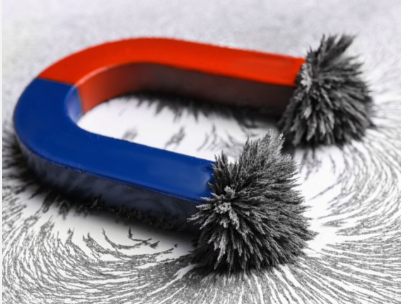
Place a magnet under a sheet of paper and sprinkle iron filings on top, and you see what the eye cannot: curved lines leaving one end and entering the other, drawn by an invisible force. This is the force that guided sailors across featureless seas, proved that the ocean floors are spreading, and protects our planet every single day from the lethal solar wind.
Where the name comes from
The word magnet comes from the region of Magnesia in Asia Minor —
modern Turkey — where a black stone was found that attracted iron. It was called the
Magnesian stone, then magnetis lithos in Greek, and from that,
magnet.
Greek legend tells of a shepherd named Magnes who was grazing his flock on a
mountain in that region when the nails of his sandals and the iron tip of his staff stuck fast to
the rocks and he could not lift his feet. Whether or not the story is true, the stone in question is
known scientifically as magnetite (Fe₃O₄) — a naturally magnetised
iron oxide, also called lodestone, "the leading stone", because it led ships at sea.
Poles and their law
Every magnet has two poles: north and south. Their rule is simple and unfailing:
- Like poles repel (north with north, south with south).
- Unlike poles attract (north with south).
If you cut a magnet in half you do not get a lone north pole and a lone south pole — you get two complete magnets, each with two poles! Repeat the cut as often as you like and the result is the same. This is radically different from electric charge, where positive can be isolated from negative. To this day no magnetic monopole has ever been observed, even though some theories predict one — it remains an open research question in physics.
Types of magnetic materials
| Type | Behaviour | Examples |
|---|---|---|
| Ferromagnetic | Strongly attracted and can remain permanently magnetised | Iron, cobalt, nickel |
| Paramagnetic | Very weakly attracted and retains no magnetisation | Aluminium, platinum |
| Diamagnetic | Weakly repelled by the field | Copper, water, bismuth |
In practice magnets are classified as permanent (keeping their magnetisation, like strong neodymium magnets), temporary (like a nail that is magnetised only while it is near a magnet) and electromagnets (a coil that works only while current flows through it). It is also important to know that high temperature destroys a magnet's magnetisation once it passes a threshold called the Curie point.
The journey of discovery through history
The beginnings and the compass
The Chinese knew the lodestone from the second century BCE and used it for divination and orientation, then developed the compass and were using it for maritime navigation by the eleventh century CE — an enormous leap in the history of travel.
Contributions of Muslim scientists
Arabs adopted the compass and extended its use, and for them it served an additional important purpose: determining the direction of the qibla from anywhere on Earth. Ibn Sina described the magnetic stone and its properties in his writings, al-Biruni studied the properties of stones including magnetism, and geographers such as al-Qazwini recorded them in their descriptions of stones and minerals. Arab sailors in the Indian Ocean also documented the use of a magnetised needle floating on water before the technique reached Europe.
William Gilbert (1600) — the Earth itself is a magnet
In his book De Magnete — the first genuinely experimental scientific book on the subject — Gilbert made a sphere of magnetite that he called a terrella, "little Earth", and moved a magnetic needle over it. The needle behaved exactly as a compass behaves on the Earth's surface. He drew his famous conclusion: the Earth itself is a giant magnet, and that is why the compass swings north — not the pole star, as had been believed.
Ørsted (1820) — the accident that united two sciences
During a lecture to students, the Dane Hans Christian Ørsted noticed that a compass needle placed near a wire deflected the moment current passed through it, and returned to its position when the current was cut. That small observation was an earthquake: electricity generates magnetism, and what had been thought to be two entirely separate sciences turned out to be two faces of one phenomenon called electromagnetism.
Faraday (1831) — and the converse is true
Michael Faraday asked the opposite question: if electricity generates magnetism, does magnetism generate electricity? After long experimentation he discovered the law of electromagnetic induction: a change in the magnetic flux through a coil induces an electromotive force in it. The key word is "change" — a magnet sitting still inside a coil generates nothing; it is the motion that generates.
Faraday was a self-taught scientist who began life as a boy in a bookbinder's shop and was not strong in mathematics; so James Clerk Maxwell came after him and cast his ideas, and Ørsted's, into four equations that united electricity, magnetism and light in a single theory and predicted the electromagnetic waves that today carry every broadcast and wireless connection in the world.
Earth's magnetism
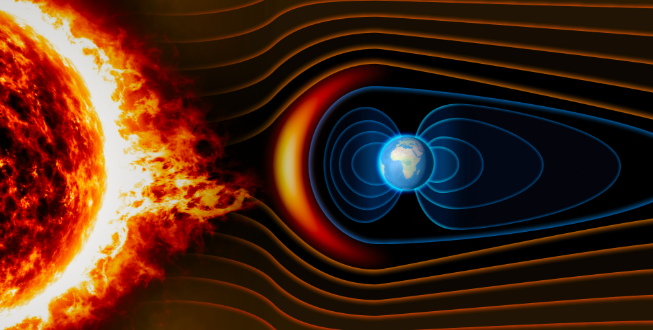
The Earth's magnetic field originates in the liquid outer core, composed mainly of molten iron and nickel. The motion of this vast conducting mass, driven by thermal convection and the planet's rotation, generates huge electric currents which in turn generate a magnetic field — a mechanism known as the geodynamo.
What we call the Earth's magnetic north pole is in fact a magnetic south pole! Otherwise the north pole of a compass needle would not be attracted to it — since it is unlike poles that attract. Also, the magnetic pole does not coincide with the geographic pole; between them lies an angle called magnetic declination that navigators must correct for.
The Earth's field is not fixed: the magnetic north pole moves tens of kilometres every year, and the rock record reveals that the field has reversed completely hundreds of times through geological history, north becoming south and south north — the last full reversal occurring about 780,000 years ago.
Magnetic stripes and the proof of seafloor spreading
Here magnetism renders one of its finest services to science. When magma rises at the mid-ocean ridges and cools, the magnetic minerals inside it align with the direction of the Earth's field at that moment and then freeze in that orientation — the rock records a permanent snapshot of the field's direction on the day it formed.
When scientists magnetically surveyed the floor of the Atlantic in the 1960s, they were astonished by a striking pattern: alternating stripes of normal and reversed magnetisation, perfectly symmetrical on both sides of the ridge like a mirror image, and growing older the farther they lay from it.
Only one explanation was possible: the crust is continuously formed at the ridge and pushed outwards to both sides, recording every magnetic reversal it passes through as a new stripe. This was the decisive evidence that proved seafloor spreading and rescued Alfred Wegener's theory of continental drift after decades of rejection — and on it all of modern earth science is built.
Magnets in our lives: old and new
Navigation
Centuries before satellites, the magnetic compass was the navigator's only instrument on the open sea, by night and by day. Thanks to it the great voyages of exploration set out and the map of the world was redrawn.
Generating electricity, and motors
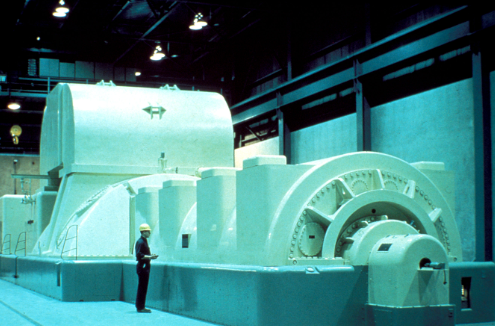
Flip any switch in your home, and the energy that lit the lamp came out of a generator working by Faraday's law: a coil rotating inside a magnetic field so that a current is induced in it. Whether the source of the motion is steam, water falling from a dam, wind or a nuclear reactor, the final step is always the same: motion inside a magnetic field.
An electric motor is the very same process in reverse: current passes through a coil inside a magnetic field, producing a torque that turns the shaft. It is the heart of the fan, the washing machine, the lift, the electric car and the maglev train.
Other modern applications
- Medicine: MRI scanners image the inside of the body using a very strong magnetic field and no ionising radiation at all.
- Data storage: hard disks and tapes record information as tiny magnetisation directions.
- Sound: every loudspeaker and microphone relies on a coil interacting with a permanent magnet.
- Industry: magnetic cranes, metal sorting and voltage transformers.
- Security: detection gates, magnetic locks and door sensors.
The protective shield and the aurora
The Sun continuously emits the solar wind: a stream of high-energy charged particles (protons and electrons) rushing outward at hundreds of kilometres per second. Without the Earth's magnetic field, this wind would have stripped away our atmosphere over millions of years — which is most likely what actually happened to Mars after it lost its magnetic field, turning it from a planet with water and a thick atmosphere into a cold, barren desert.
Here, the magnetosphere deflects most of these particles around the planet and traps some of them in the Van Allen radiation belts. But at the poles, where the field lines meet the Earth, some particles leak into the upper atmosphere and collide with its atoms — and there the show begins.
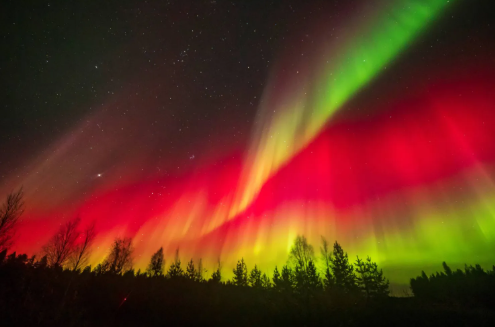
The charged particles strike oxygen and nitrogen atoms and excite them, and when those atoms fall back to their stable state they release the excess energy as coloured light:
- Green: oxygen at an altitude of roughly 100 – 300 km — the most familiar and most common colour.
- Red: oxygen at higher altitudes, above 300 km.
- Blue and violet: nitrogen at lower altitudes.
In the north it is called the Aurora Borealis and in the south the Aurora Australis. And it is not merely a beautiful sight — it is visible evidence that an invisible shield is working above our heads at this very moment.
A stone that stuck to the nails of a shepherd's sandals became a compass that opened the seas, then revealed that the Earth is a magnet, then proved that the continents move, then lit the homes of the whole world — and at every moment it shields our planet from the solar wind and paints in the polar sky the most beautiful picture nature knows.