Radio Waves — The Invisible Network Carrying Our Civilisation
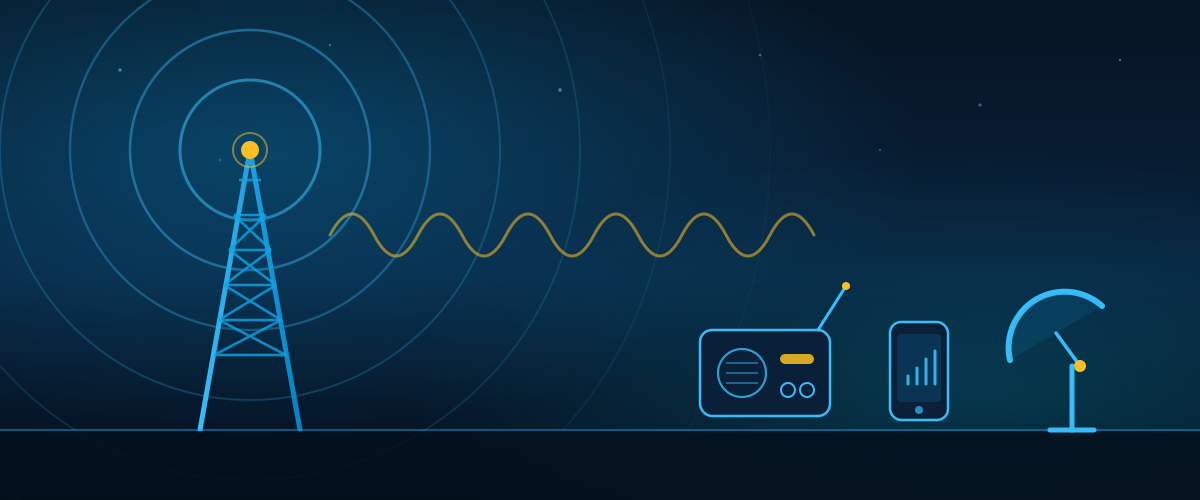
Stop for a moment and consider this: in the room where you are sitting right now — in this very second — the signals of dozens of radio stations are passing through your body, along with television broadcasts, phone calls belonging to people you have never met, packets of Wi-Fi data, and signals from satellites orbiting twenty thousand kilometres above you. All of them are passing through you right now, and you feel not one of them.
We live submerged in an ocean of waves we cannot see, hear or touch. And all of it began with a set of mathematical equations written by a man who never lived to see a single one of them.
First: what are radio waves?
Radio waves are a form of electromagnetic radiation — exactly like the light by which you are reading these words, like X-rays, and like the warmth of the Sun on your face. The difference between them all is not one of nature, but only of frequency.
This is a point many people miss: a radio wave and visible light are the same thing. If your eye could see far lower frequencies, you would watch radio broadcasts pouring out of transmitter masts just as you see the glow of a lamp. Nature is one; it is only the eye that is limited.
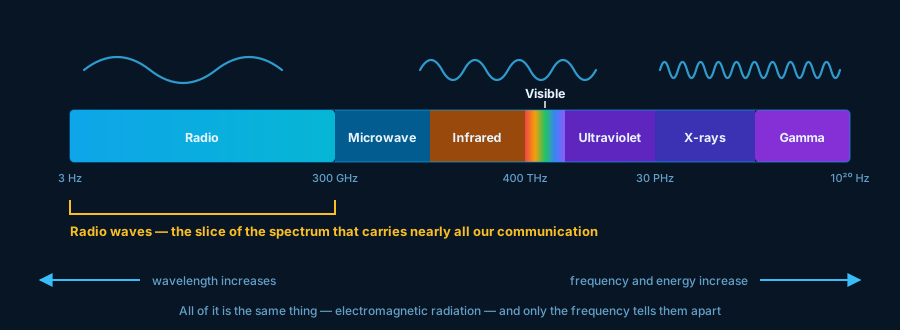
- Frequency range: from 3 Hz to 300 GHz.
- Wavelength: from a single millimetre to around 100,000 kilometres.
- Speed: the speed of light itself — about
300,000 km/sin vacuum. - Penetration: passes through walls, buildings, the atmosphere and even clouds.
- Energy: very low, which makes it non-ionising radiation — it lacks the energy to strip electrons from atoms, and so it does not damage DNA the way X-rays and gamma rays do.
Frequency and wavelength are tied together by a simple relation that governs everything else in this article:
c = f × λ
where c is the speed of light, f the frequency and λ the
wavelength. Since c is fixed, the higher the frequency, the shorter the
wavelength — and this inverse relationship is exactly why long waves cross continents
while 5G signals barely make it to the end of the street.
Second: the story of the discovery
Maxwell — the mathematical prophecy (1865)
James Clerk Maxwell (Scottish, 1831–1879) built no apparatus and ran no experiment. All he did was gather the laws of electricity and magnetism into four equations — and then look at what they were saying.
What they said was astonishing: a changing electric field generates a magnetic field, and a changing magnetic field generates an electric one — so each gives birth to the other in a chain that propagates through space as a wave. He then calculated the speed of that wave from purely electrical constants, and out came the number: about 300,000 kilometres per second.
That is exactly the measured speed of light. Maxwell drew the bold conclusion: light itself is an electromagnetic wave. And if so, there must exist other waves at other frequencies that the eye cannot see. He died in 1879 without ever seeing one.
Hertz — the spark that proved everything (1887)
Eight years after Maxwell's death, the German Heinrich Hertz (1857–1894) built a simple device: a circuit producing an electric spark between two metal spheres, and, metres away, a loop of wire with a small gap in it. When the first spark jumped, a tiny spark jumped in the distant loop too — with no wire connecting them.
That was the first wireless transmission and reception in history. Hertz measured the speed of the waves and showed that they reflect, refract and polarise exactly as light does. Maxwell's theory had become a physical fact.
Asked what use his discovery might have, Hertz replied: "Nothing at all. This is merely an experiment proving that Professor Maxwell was right." Pressed on what would come of it, he answered: "Nothing, I suppose."
— Heinrich Hertz, on the discovery that all modern communication was built upon
Hertz died at just thirty-six, never living to see that his "useless experiment" would become the foundation of radio, television, mobile phones and the internet. In his honour the international unit of frequency was named the hertz (Hz) — so every time you read "2.4 GHz" on the router in your home, you are pronouncing the name of a man who thought his discovery was worthless.
Marconi — from experiment to the world (1895–1901)
The Italian Guglielmo Marconi (1874–1937) read about Hertz's experiments at the age of twenty and asked the question Hertz never had: why not make these waves carry a message?
He began in the attic of his father's house in 1895, and by raising the antenna high and earthing the other side he pushed the range from metres to 2.4 kilometres. He then moved to Britain, where he found funding and support.
In December 1901 came his greatest achievement: he transmitted the letter S in Morse code (three taps) from Poldhu in Cornwall, England, and it was received at St John's in Newfoundland, Canada — across the Atlantic, a distance of roughly 3,400 kilometres.
Experts had declared this impossible: waves travel in straight lines and the Earth is curved, so the signal ought to have shot off into space. Neither Marconi nor his critics knew that there is a charged layer in the upper atmosphere that reflects the waves back down — the ionosphere, which would not be discovered for another twenty years. Marconi succeeded because of a phenomenon he knew nothing about, and received the Nobel Prize in Physics in 1909.
Tesla — the rival vindicated too late
Many historians hold that Nikola Tesla (Serbian-American, 1856–1943) came first to several fundamental principles. He gave a public demonstration of wireless transmission in 1893 and patented work on resonant circuits — the very principles that make tuning to one particular station possible at all.
In 1943, a few months after Tesla died in poverty, the United States Supreme Court invalidated several of Marconi's principal patent claims, recognising the priority of the work of Tesla, Oliver Lodge and John Stone. But the ruling came far too late, and popular history had already made up its mind.
Armstrong — the inventor of FM and his tragic end
There is a fourth name rarely mentioned, though you hear its effect every day: Edwin Armstrong (American, 1890–1954), who in 1933 invented frequency modulation — FM — and solved the interference problem that had defeated everyone else.
But his invention threatened the enormous investments of the AM broadcasting companies, and he was drawn into legal battles that drained his fortune and his health for more than twenty years. In 1954, worn down by the fighting, he took his own life. After his death his widow won the lawsuits one after another. Every time you listen to a clear FM broadcast, you are hearing the legacy of a man who reaped nothing from his invention but enmity.
Third: the types of radio waves
The broad radio spectrum is divided into bands, and each band has an entirely different personality — in how far it reaches, how well it penetrates obstacles, and how much data it can carry:
| Band | Frequency | Wavelength | Coverage | Main uses |
|---|---|---|---|---|
| ELF / VLF extremely long |
3 Hz – 30 kHz | 10 – 100,000 km | planetary | Communication with submerged submarines, earthquake and storm monitoring |
| LW long wave |
30 – 300 kHz | 1 – 10 km | thousands of km | Maritime navigation, broadcasting in Europe |
| MW / AM medium wave |
300 kHz – 3 MHz | 100 m – 1 km | hundreds of km | AM broadcasting — and its reach doubles at night |
| SW / HF short wave |
3 – 30 MHz | 10 – 100 m | global | International broadcasting, amateur radio, disaster communication |
| VHF / FM very high |
30 – 300 MHz | 1 – 10 m | 50 – 150 km | FM radio, terrestrial television, aviation, police radios |
| UHF ultra high |
300 MHz – 3 GHz | 10 cm – 1 m | local | Mobile phones, Wi-Fi, Bluetooth, GPS, digital television |
| SHF / EHF microwaves |
3 – 300 GHz | 1 mm – 10 cm | line of sight | 5G, satellites, radar, high-speed Wi-Fi |
The higher the frequency: the faster the data rate, the shorter the reach, and
the weaker the penetration of obstacles.
That is why you can hear a shortwave station from another continent at poor quality, while an
ultra-fast 5G network needs a mast in every neighbourhood. There is no ideal
wave — only a permanent trade-off between reach and capacity.
Fourth: the difference between AM and FM
An electromagnetic wave on its own carries no information; it is a monotonous, repeating oscillation that means nothing. To make it carry sound we must modulate it — that is, vary one of its properties in step with the sound. And here the methods split into two schools:
AM — Amplitude Modulation
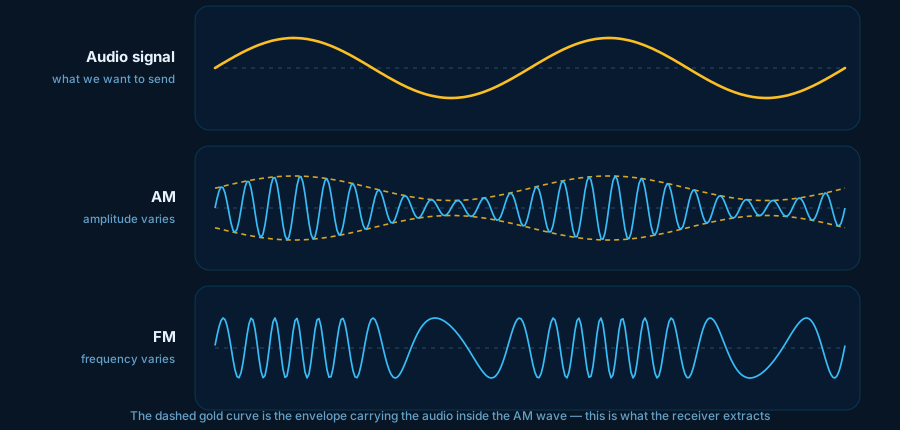
The frequency stays fixed and the height of the wave (its amplitude) varies with the loudness of the sound. Look at the middle panel of the diagram: the dashed gold line tracing the outline of the wave is the audio signal itself — and that is what the receiver extracts and turns back into sound.
AM stations normally operate in the medium-wave band between 540 and 1600 kHz.
FM — Frequency Modulation
The height stays fixed and the spacing of the waves (their frequency) varies with the sound. Notice in the bottom panel how the waves crowd together and spread apart while their height never changes at all.
FM stations operate in the VHF band between 87.5 and 108 MHz.
Because most natural interference (lightning, a car engine, a kitchen blender) appears as sudden changes in intensity — that is, in amplitude. Since AM carries its information in the amplitude itself, the interference merges into the sound and there is no way to separate it. FM, by contrast, carries the information in the frequency, so the receiver can simply clip off any variation in height and discard it — the interference vanishes without touching the message. That is Armstrong's genius in a single sentence.
| Point of comparison | AM | FM |
|---|---|---|
| What varies | Amplitude (height) | Frequency (spacing) |
| Sound quality | Moderate | High, and supports stereo |
| Interference resistance | Poor | Excellent |
| Coverage | Hundreds of km | 50 – 80 km |
| Penetration of hills and buildings | Good | Poor — needs line of sight |
| Equipment cost | Low and simple | Higher |
SW — short waves and the ionosphere trick
The most remarkable of them all. Short waves reflect off the ionosphere — a layer of the atmosphere 50 to 400 kilometres up whose atoms are ionised by sunlight, turning it into a mirror for short waves. Through successive bounces between the ionosphere and the ground, the wave covers thousands of kilometres with no satellite and no infrastructure whatsoever.
This explains something you may have noticed: why do distant stations come in so much better at night? Because during the day the Sun maintains a lower layer (the D layer) that absorbs the waves and weakens them. When the Sun sets that absorbing layer disappears, so the waves rise to the reflecting upper layers and travel far further. Night opens a road for the waves that daylight closes.
To this day SW remains the lifeline when every network fails: in natural disasters and wars, when the masts fall and the internet goes down, amateur radio operators can still reach the world with a set and a wire antenna — because they depend on no infrastructure that can be destroyed.
Fifth: how does the wave travel from the transmitter to your device?
Ground wave
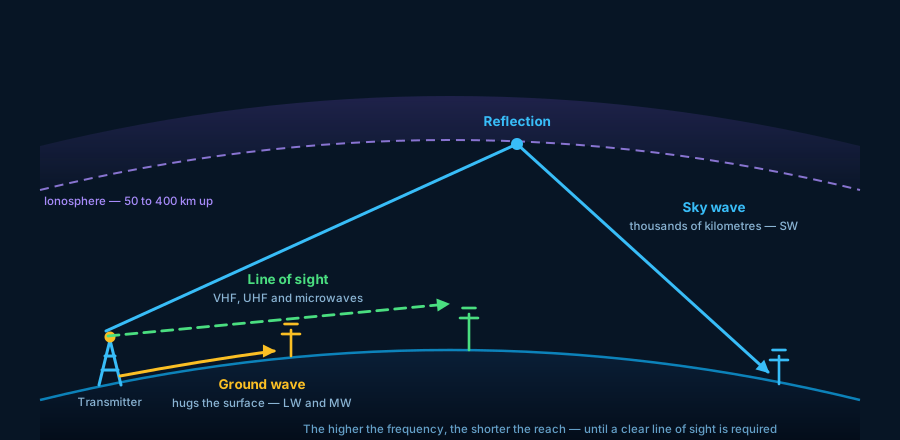
Creeps along the Earth's surface, following its curvature; used by LW and MW. It fades gradually as the soil absorbs its energy.
Sky wave
Rises, reflects off the ionosphere and comes back down, sometimes bouncing repeatedly. This is SW's road to the far side of the planet.
Line of sight
A straight line between two antennas, used by VHF, UHF and microwaves. Limited by the horizon, so it needs tall masts or satellites.
Sixth: where do radio waves meet you in your day?
The mobile phone
From the second generation to the fifth, every network relies on UHF and microwaves. In its highest bands, 5G uses millimetre waves at 24–100 GHz, reaching speeds beyond 10 gigabits per second — but the price of that speed is a range of only a few hundred metres, blocked by a leaf or a pane of glass. This is why 5G needs an enormous number of small cells instead of the old giant masts.
Wi-Fi and Bluetooth
Both work in the 2.4 GHz and 5 GHz bands (and Wi-Fi 6E added the 6 GHz band). Bluetooth uses 2.4 GHz at very low transmit power, which is why its range is limited to a few metres.
And here is the explanation for a problem you meet at home: why does Wi-Fi weaken when the microwave oven is running? Because both operate in roughly the same band (2.4 GHz), and a tiny leak from the oven is enough to drown the router's weak signal in noise.
GPS
Works at 1.575 GHz. Each satellite broadcasts a signal carrying an extremely precise timestamp from an atomic clock on board. Your device measures the time difference between transmission and arrival to work out its distance from each satellite — and by intersecting at least four of them, your position is fixed to within a few metres.
Radar
Short for Radio Detection And Ranging. It sends a radio pulse, which bounces off an object and returns; the travel time gives the distance, and the change in the frequency of the returning wave (the Doppler effect) gives the speed. It is used in airports and ships, in storm tracking, in police speed guns, and in the collision-avoidance systems of modern cars.
The microwave oven
Operates at 2.45 GHz, making water molecules — which are polar — oscillate and rub against one another, so heat is generated from inside the food rather than from its surface as in a conventional oven.
It is often said that 2.45 GHz is the "resonant frequency of the water molecule" — and this is not true. Water's absorption of microwaves is broad with no sharp peak there; in fact it absorbs more strongly at higher frequencies. The real reasons for choosing this frequency are practical: it lies in the ISM band allocated internationally for licence-free industrial and medical use, and it strikes a good balance between absorption and depth of penetration — because a strongly absorbed frequency would burn the surface of the food and leave its centre cold.
The principle of the microwave oven was discovered by accident in 1945, when the American engineer Percy Spencer stood in front of an operating radar magnetron and noticed that the sweet in his pocket had melted. He then tried putting corn kernels in front of the device and got popcorn, and next tried an egg, which exploded in a colleague's face. The first commercial oven, built in 1947, stood 1.8 metres tall, weighed 340 kilograms — and needed water cooling.
Magnetic resonance imaging (MRI)
One of the most elegant and life-saving applications of radio. The patient is placed in a very strong magnetic field, which aligns the hydrogen nuclei in the body (and the body is mostly water). A radio pulse is then sent in, knocking those nuclei out of alignment; as they return, they emit a faint radio signal that the scanner picks up and builds into a detailed image of the soft tissue.
Its great advantage is that it uses no ionising radiation at all — no X-rays and no radioactivity — making it safe to repeat and safe in pregnancy, unlike a CT scan.
Radio astronomy
Not all radio waves are made by humans; the universe itself broadcasts. Galaxies, pulsars and gas clouds emit radio waves that radio telescopes collect, revealing what visible light cannot show because cosmic dust blocks it.
The most famous capture of all is the cosmic microwave background — the afterglow of the Big Bang itself, discovered by accident in 1965 when its discoverers assumed the noise in their antenna was caused by pigeon droppings. The largest radio telescope in the world today is China's FAST, 500 metres across.
Conclusion
This story began with equations on paper that nobody believed, passed through a small spark whose maker thought it useless, and then through a stubborn young man who sent a single letter across an ocean. Today barely a moment of your life passes without thousands of messages you cannot see passing through you.
And perhaps the deepest lesson radio waves taught us is not technical but human: that a scientist cannot judge the value of their own discovery. Hertz said "nothing"; Maxwell died before seeing a single wave; Tesla died poor before the court vindicated him; and Armstrong was destroyed by what he invented. Then what they pursued purely for the love of knowing became the device now sitting in your pocket.
That alone is reason enough never to ask of scientific research: but what is it good for?