Tickling the Dragon's Tail — The Demon Core That Killed Two Scientists
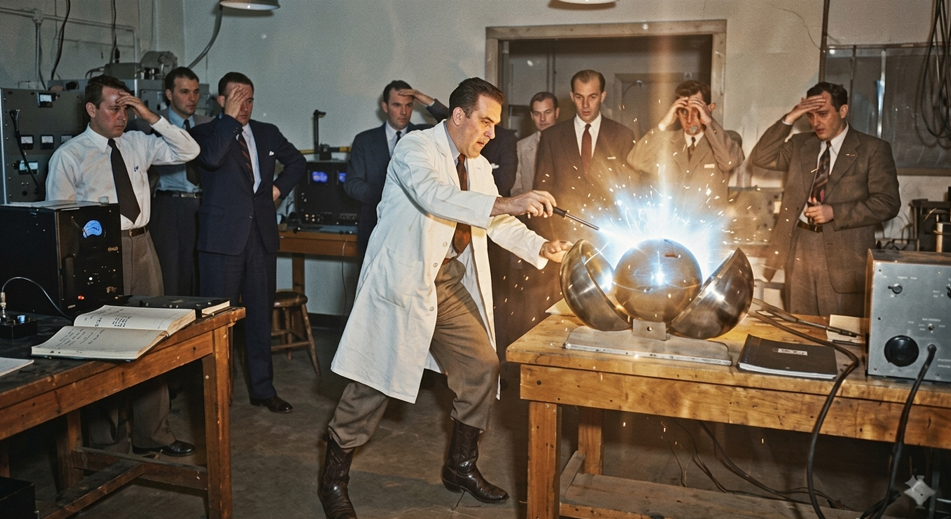
At Los Alamos in New Mexico there was a small, gleaming metal sphere, 89 millimetres across — a little smaller than a tennis ball — weighing 6.2 kilograms. It was always warm to the touch; its own decay heat was enough to feel through your fingers. It had been cast to be the heart of a third atomic bomb over Japan, but the war ended before it could be shipped.
So it stayed in the laboratory as research material. And in less than nine months it killed two men, in almost exactly the same way, in the same room, and — in both cases — on the twenty-first day of the month. From then on it had a name among the physicists: the Demon Core.
First: what exactly was this "core"?
The core, or pit, is the fissile heart of a nuclear weapon. This one was a sphere of plutonium-239, cast as two hemispheres with a ring between them, nickel-plated against corrosion and alloyed with a little gallium to stabilise it in the easily-worked "delta" phase.
The Manhattan Project produced it in the summer of 1945 and its paperwork called it "Rufus". The plan was for it to be the third bomb; the military command was told it would be ready for delivery on a Japanese target around 19 August 1945. Japan announced its surrender on 15 August, the shipment was cancelled, and the core stayed at Los Alamos in the hands of the research division.
Because a nuclear explosion requires the core to be crushed by shaped explosives until its density multiplies within a millionth of a second. On a laboratory bench the worst that can happen is a criticality excursion: a burst of fissions lasting a fraction of a second, releasing a torrent of neutrons and gamma rays — with no bang and no destruction, but lethal to anyone standing beside it.
The physics behind the story: what does "critical" mean?
Each fission of a plutonium nucleus releases about three neutrons on average. What happens to those neutrons decides everything, and it is summarised in a single number, the multiplication factor k: the number of fissions in the next generation divided by the number in the current one.
| State | Value of k | What happens |
|---|---|---|
| Subcritical | k < 1 | The reaction dies away on its own |
| Critical | k = 1 | The reaction holds steady — this is a working reactor |
| Supercritical | k > 1 | The reaction multiplies — power grows exponentially |
| Prompt supercritical | k > 1 on prompt neutrons alone | Multiplication happens in millionths of a second — this is what occurred in both accidents |
The secret of the neutron reflector
The core alone on the bench was safely subcritical: the neutrons born inside it escaped through its surface into the air and never came back. But surround it with a material that reflects neutrons — tungsten carbide or beryllium — and without adding a single atom of plutonium you have raised k, because you have handed the core back its escaping neutrons.
And that is exactly what the scientists were measuring: how much reflector does it take to reach criticality? A necessary question for designing weapons and reactors — but answering it meant walking towards the edge one step at a time, then stopping a hair's breadth short.
The phrase is attributed to the physicist Richard Feynman, who described these hands-on experiments as "tickling the tail of a sleeping dragon": you walk up to the beast and touch it lightly to measure its reaction, confident that you will pull your hand back in time. The trouble is that the dragon needs no more than half a second to wake.
Accident one: Harry Daghlian — 21 August 1945
The victim
Harry K. Daghlian Jr. — an Armenian-American physicist, 24 years old, a graduate student seconded to the Manhattan Project.
The time
Tuesday night, 21 August 1945, around 9:55 pm — just six days after Japan's surrender.
The place
"Omega Site" in Pajarito Canyon, part of the Los Alamos Laboratory, New Mexico.
Daghlian returned to the laboratory at night to finish a neutron-reflector experiment. He was building a wall of tungsten carbide bricks around the core, one brick at a time, watching the neutron counter after each addition to see how close he was getting to criticality.
That night he broke an explicit rule: never run a criticality experiment alone. The only other person in the hall was a security guard, Robert Hemmerly, sitting some three metres away and with no part in the experiment.
Daghlian lifted the final brick and held it over the centre of the stack, ready to set it down. At that instant the counter jumped sharply, and he realised that this particular brick would push the assembly supercritical. As he withdrew his hand the brick slipped from his fingers and fell into the middle of the stack.
The reflector closed, k leapt above one instantly, a blue glow flooded the space around the bench, and Daghlian felt a tingling in his hand. He had only one option: reach into the glowing stack and knock the brick away — then partly dismantle the wall with his bare hands to shut the reaction down for good.
The excursion lasted fractions of a second and is estimated to have produced about 10¹⁶ fissions. There was no sound, nothing broke, the room did not heat up. All that happened was that a man stood in a torrent of neutrons for a few seconds.
The dose, and the end
Daghlian's whole-body dose was estimated at about 5.1 sieverts (510 rem) — above the median lethal dose (LD50) of roughly 4.5 Sv. His hands, which had been closest to the core, took a local dose many times higher still.
Nausea began within hours. Then his right hand swelled and blistered with deep radiation burns that ended in gangrene; his white cell count collapsed and his immunity with it; he developed fever, then fell into a coma. He died on 15 September 1945, after 25 days, of acute radiation syndrome. He was 24 years old.
The guard, Hemmerly, survived with a far smaller dose (estimated at around a tenth of a sievert), because he was far away — the inverse-square law saved him. He died thirty-three years later, in 1978, of acute myelogenous leukaemia at the age of 62; no firm causal link to the accident can be established.
Accident two: Louis Slotin — 21 May 1946
Nine months passed. Everyone at Los Alamos knew how Daghlian had died. And yet the hands-on experiments on that same core continued.
The victim
Louis Alexander Slotin — a Canadian physicist from Winnipeg, 35 years old, with a doctorate from King's College London, and the man who had assembled the core for the Trinity test itself.
The time
Tuesday 21 May 1946, around 3:20 in the afternoon.
The place
Essentially the same hall at Omega Site — Los Alamos.
Slotin was about to leave Los Alamos and return to the University of Chicago, and had come to hand his duties over to his successor, Alvin Graves. The last of the techniques Graves had to master was the "two half-shell" experiment: enclosing the core in two hemispheres of beryllium — the strongest neutron reflector available — while keeping a small gap between them, then narrowing that gap gradually and watching the assembly approach criticality.
The approved procedure required shims between the shells, making full closure mechanically impossible. But Slotin — who had run the experiment dozens of times — had long since dispensed with them in favour of something faster and lighter: he inserted the blade of a screwdriver between the shells and tilted it with his left hand to control the gap, holding the upper shell by his thumb through a hole in its top.
There were eight people in the room, Slotin included. As he narrowed the gap, the screwdriver slipped — and the upper shell dropped and closed completely over the core.
Those present saw a blue flash and felt a wave of heat on their faces. Slotin reported an immediate sour, metallic taste in his mouth and a fierce burning in his left hand.
In less than a second he snatched the top shell away with his hand and flung it to the floor, ending the reaction. The excursion is estimated at about 3×10¹⁵ fissions. With that motion Slotin stopped the accident and spared the other seven far larger doses — and signed his own death warrant, because his hands had been at the heart of the neutron flood.
Why do we know each man's dose?
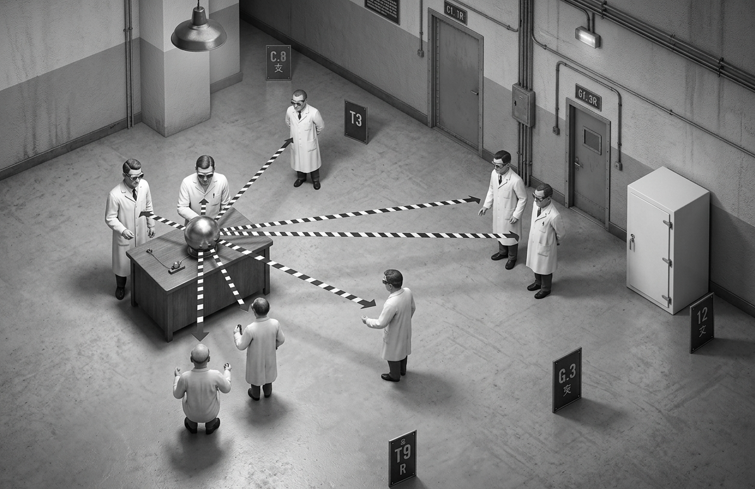
Because Slotin did something remarkable immediately afterwards: he got everyone out of the room, then drew a diagram marking where each person had been standing and how their body had been oriented at the moment of the flash. Thanks to that sketch — together with measurements on metal objects in the room that had been made radioactive by the burst — physicians and physicists were able to reconstruct each individual's dose from their distance to the bench.
Doses and fates
The figures below are the values commonly cited in Los Alamos reports; they vary slightly from one source to another:
| Name | Position | Estimated dose | Fate |
|---|---|---|---|
| Louis Slotin | Hands directly over the core | ~10 Gy (≈2100 rem) | Died 9 days later — 30 May 1946 |
| Alvin Graves | Directly over Slotin's shoulder (~1 m) | ~1.7 Gy (≈360 rem) | Survived — but with acute radiation sickness, later neurological problems and cataracts; died of a heart attack in 1965 |
| Samuel Allan Kline | Mid-room | ~1.3 Gy (≈250 rem) | Survived and lived for decades |
| Marion Cieslicki | Further back | ~0.3 Gy (≈62 rem) | Died in 1965 of acute myelogenous leukaemia |
| Dwight Smith Young | Further back | ~0.3 Gy (≈62 rem) | Died in 1975 of aplastic anaemia and pneumonia |
| Raemer Schreiber | Near the door | ~0.04 Gy (≈9 rem) | Survived, lived until 1998 — and became a senior figure at Los Alamos |
| Theodore Perlman | Far | ~0.03 Gy (≈7 rem) | Survived |
| Patrick Cleary (guard) | Farthest | ~0.02 Gy (≈4 rem) | Survived the accident — later killed in the Korean War, 1950 |
Note the enormous gap: Slotin and Graves were less than a metre apart, yet Slotin received roughly six times Graves's dose — because Slotin's own body acted as a human shield between the core and the others, and because intensity falls with the square of the distance.
Nine days
On the way to the hospital Slotin told a colleague, in substance: "You'll be all right — but I think I'm finished." He knew exactly what was coming, because he had lived through the details of Daghlian's death nine months earlier.
- Day 1: Severe vomiting and diarrhoea — the signature of a lethal dose.
- Days 2–3: The deceptive "latent phase": an apparent recovery in which the patient feels well, while the bone marrow has in fact already been destroyed.
- Days 4–6: Swollen hands, blistering and radiation burns, collapse of the white cell count, and paralysis of the intestines.
- Days 7–9: Cascading organ failure, then coma. He died on 30 May 1946; his doctors described the state as "a total disintegration of bodily functions".
His body was taken home to Winnipeg in Canada and buried there. His country received him as a man who had sacrificed himself to save seven others.
The blue glow in criticality accidents is often said to be Cherenkov radiation, and in air that is not accurate. Cherenkov light requires a medium with a substantially high refractive index — water in a reactor pool, where the famous blue glow really does appear. In air the refractive index is almost exactly one, so the contribution is negligible. The flash the witnesses saw was most likely caused by the ionisation and excitation of nitrogen and oxygen molecules in the air by the radiation burst, which emit blue-violet light as they fall back to their ground state — the same phenomenon that lights up the aurora.
Why did both accidents happen? An anatomy of the causes
It is easy to say "recklessness", but a real analysis reveals layer upon layer of failure:
1) Wartime culture
The Manhattan Project was a frantic race against the clock, and it bred a habit of skipping slow procedures for the sake of speed. The war ended — the habit did not.
2) Bare-handed work
No barrier, no shielding, no distance. A human body sat centimetres from fissile material, and the only safety measure was a steady hand.
3) Removing the mechanical barrier
The shims that prevented full closure were a passive safety barrier that worked even when the human failed. Replacing them with a screwdriver moved the whole of safety onto one person's skill.
4) Confidence bred by repetition
Slotin had run the experiment dozens of times without incident. That is precisely what safety engineering calls normalisation of deviance: repeated success with a dangerous method makes it feel safe.
5) Breaking the two-person rule
Daghlian worked alone at night, so there was nobody to stop him, warn him, or intervene when the brick fell.
6) Failing to learn from the first accident
The gravest cause of all: after Daghlian's death the procedures were not fundamentally changed, so the same scenario replayed on the same core nine months later.
Enrico Fermi is said to have warned Slotin and his colleagues bluntly: "If you keep doing that experiment that way, you'll be dead within a year."
— a warning widely recounted in the lore of Los Alamos
What became of the core itself?
The core was scheduled for use in the Operation Crossroads nuclear tests at Bikini Atoll in the summer of 1946. But after the second accident its properties had changed: radioactive fission products had built up inside it and it needed time to cool down, so it was dropped from the test schedule.
In the summer of 1946 it was melted down, returned to the general stockpile, and its material recast into other pits. The demon core, as an object, no longer exists; its atoms dissolved into other weapons, and what remained of it was the name and the lesson.
The consequences — how two accidents changed the nuclear world
1) The end of hands-on criticality experiments
Immediately after Slotin's death, Los Alamos banned every experiment in which a human hand approached a critical assembly. This was a fundamental shift in philosophy: the question was no longer "how do we train people to be careful?" but "how do we design the system so that nobody dies even when a person makes a mistake?"
2) Remotely operated machines
The experiments moved to automated machines at Pajarito Site — the best known being Godiva and Jezebel — run from a control room hundreds of metres away behind earth berms, using electric actuators and television cameras. The idea is simple and decisive: if the dragon must be woken, let it be woken with nobody in the room.
3) The birth of criticality safety as a discipline
Out of these two accidents grew an engineering field in its own right — Nuclear Criticality Safety — with strict rules, among them:
- The double contingency principle: at least two independent failures must occur before criticality becomes possible — never one.
- Control by geometry, not by attention: vessels, shapes and spacings that make criticality physically impossible however much material accumulates.
- Criticality alarm systems: detectors that sound an immediate evacuation alarm on any sudden radiation burst.
- Hard mass and storage limits at every site handling fissile material.
4) Medical data paid for in human lives
The two cases documented, day by day and in fine detail, the course of acute radiation syndrome at precisely known doses — data impossible to obtain by any other ethical means. And Slotin's diagram of where everyone stood became a reference model for reconstructing doses after radiation accidents, right up to the present.
Since then, more than sixty criticality accidents have been recorded worldwide in nuclear facilities and laboratories, claiming roughly 21 lives. The two accidents in this article are the first two on that list — and by far the most famous.
Conclusion
The demon core was not demonic. It was a sphere of metal obeying the laws of physics exactly, with no mood and no intent: bring a reflector closer and k rises; let k rise and the fission count explodes. The sphere did what it always does, every time, without a single exception.
The demon was on the other side of the bench: in the belief that skill can substitute for procedure, that what worked ninety-nine times will work the hundredth, and that a steady hand is a safety barrier.
Two young men died — one in twenty-five days, the other in nine — so that the world could learn a rule that seems obvious today: never put your body where a mistake cannot be forgiven. Every nuclear safety protocol that strikes us now as needlessly elaborate and tedious was in fact written at a terrible price, on a bench in New Mexico, in a blue flash that lasted less than a second.